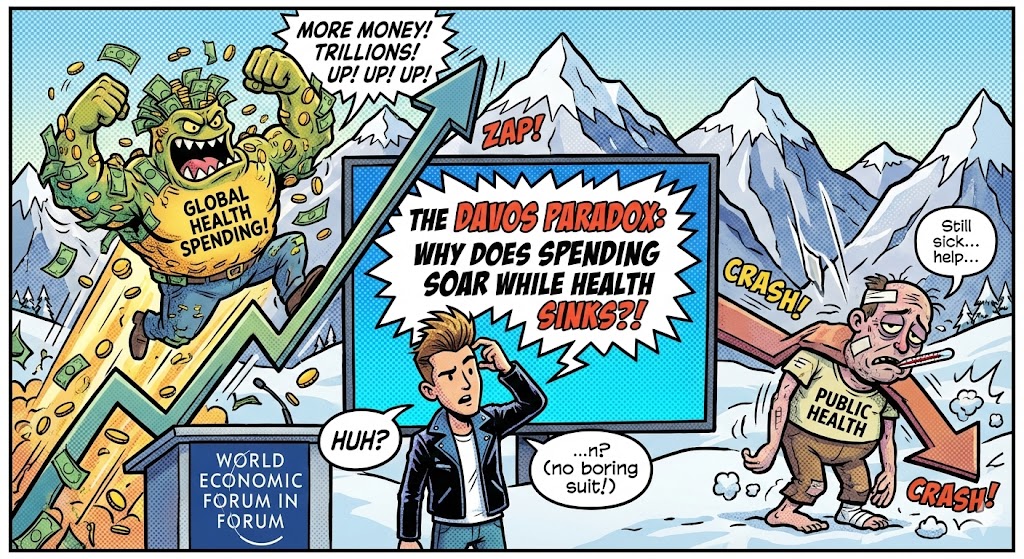
Global healthcare has entered a “vicious cycle,” where expenditures are rising exponentially worldwide, yet the quality of services and, critically, public health metrics often stagnate or even decline. At the World Economic Forum (WEF) in Davos, global leaders grappled with a fundamental question: Is healthcare an unavoidable money pit for public budgets, or is it the single most crucial investment in a nation’s future?
NEWSROOM IN listened to the speakers’ presentations and offers a brief summary of their perspectives:
More Than Just Economics
Discussions during the WEF session indicated that the old “break-fix” model—treating diseases after they have already occurred—is no longer economically viable. The world stands on the threshold of a painful but unavoidable paradigm shift: moving away from viewing medicine as a compulsory “cost” toward recognizing it as a strategic “investment.”
Nina Warcken, Germany’s Federal Minister of Health, set the tone for the discussion. She expanded the issue far beyond balance sheets, stating that “investing in healthcare is investing in democracy.”
This thesis resonates with the growing global understanding that a state’s failure to ensure basic citizen health undermines trust in government institutions. When people cannot receive care or face financial ruin due to medical bills, it fuels social instability and populism. The health of a nation thus becomes a matter of national security and political stability.
The Market Cannot Cope Alone
Why can’t healthcare simply be entrusted to the “invisible hand of the market”? Stefanie Stantcheva, a Professor of Political Economy at Harvard, explained that healthcare is a unique sector where classic market mechanisms fail due to numerous external factors.
The private market excels at selling expensive procedures but has no incentive to invest in public health, pandemic prevention, or the well-being of low-income populations. “Government policy plays a vital role here,” Stantcheva emphasized, pointing out that without smart regulation and public investment, the system will only serve the wealthy, leaving the majority behind.
Technology: Personalization Without Human Input?
The primary hope for breaking the vicious cycle of “rising costs—falling quality” rests on technology. Bernd Montag, CEO of Siemens Healthineers, called for “personalization across the entire process scale.”
His idea involves using technology throughout the entire journey, from early prevention to precise diagnostics and therapy. Montag’s key caveat is that this must happen “without increasing the human factor in the process.”
This statement directly addresses the elephant in the room widely discussed in the Davos corridors—Artificial Intelligence (AI). Healthcare systems worldwide suffer from staff shortages and physician burnout. The main goal of AI in the coming years is not so much to replace doctors in diagnostics as it is to take over routine tasks: charting, analyzing images, and administrative work. AI is precisely what can allow personalized approaches to be scaled up without having to hire an army of new doctors, who are simply unavailable.
The Political Trap of Short-Termism
However, even the best technologies clash with political reality. Michel Demaré, Chairman of the Board of AstraZeneca, pointed to the main structural problem: mismatched cycles.
Healthcare requires strategies calculated over 10 to 20 years (for example, prevention programs for diabetes or cardiovascular diseases bear fruit decades later). But politicians operate on four-year election cycles. They need quick wins they can present to voters “here and now,” and long-term investments in prevention do not yield immediate political dividends. Demaré stressed that “a holistic and long-term approach will prove to be the only right path” but acknowledged the difficulty of implementing this with temporary governments.
The Strategic Blueprint
If we accept that healthcare is an investment, how should it be managed? Sunita Reddy, Managing Director of India’s Apollo Hospitals Enterprise, proposed a pragmatic approach based on the experience of India’s vast and complex market. She argued that before implementing expensive digital systems, the basic strategy must be sorted out:
- Clearly define who pays for the services (the state, insurers, patients).
- Determine the desired clinical outcomes (what constitutes successful treatment).
- Establish comprehensive healthcare networks. Only after these steps should data be integrated into a digital system. Digitalizing chaos will only lead to digital chaos.
Future Strategies for Global Healthcare
The discussion in Davos demonstrated that the first crucial step is fundamentally rethinking healthcare—not as a budgetary black hole, but as the foundation for a productive economy and a stable democracy.
The main challenge in the coming years is finding a balance between implementing breakthrough technologies (AI, genomics) that can reduce costs in the long term, and the immediate necessity of ensuring basic access to medicine now, all while overcoming the political short-sightedness inherent in electoral cycles. Those countries that successfully transform healthcare from an expense item into an investment portfolio will gain the main competitive advantage of the 21st century: healthy and productive human capital.