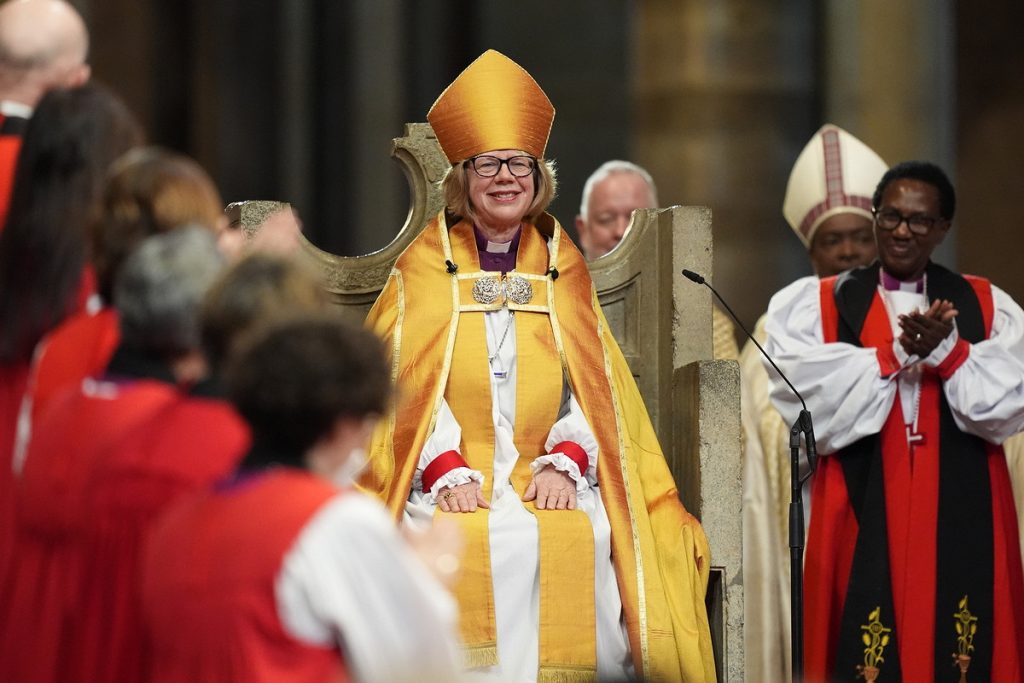
Sarah Mullally has been enthroned as the first female Archbishop of Canterbury, becoming the first woman to serve as the spiritual leader of the Church of England in its 1,400-year history. According to Sky News, the ceremony took place at Canterbury Cathedral. More than 2,000 people attended, including Prince William, British Prime Minister Keir Starmer, and representatives from the Vatican and the Orthodox Church.
Archbishop of Canterbury: Nurse to Spiritual Leader
Sarah Mullally (née Bowser) was born in 1962 in Surrey. Her path to the highest clerical office was unconventional. Mullally received a medical education and had a career in healthcare, serving as the Chief Nursing Officer for the UK National Health Service (NHS) from 1999 to 2004.
Mullally was ordained in 2002. In 2015, she became the fourth woman in the Church of England to be consecrated as a bishop. Three years later, she was appointed to the position of Bishop of London.
How the Head of the Church of England Is Chosen
The appointment of a new archbishop consists of several stages. A College of Canons selects the candidate, who must then be approved by the British monarch. The King is the formal head of the Church of England, while the Archbishop of Canterbury is its spiritual leader and the head of the global Anglican Communion.
Sarah Mullally’s appointment was announced in October 2025. She was officially confirmed in the post during a ceremony at St Paul’s Cathedral in January 2026. However, the enthronement at Canterbury Cathedral serves as the symbolic and formal beginning of her ministry.
NEWSROOM IN notes that the office of Archbishop of Canterbury has existed for nearly 1,500 years. Saint Augustine of Canterbury was the first to hold the post in 597, when the church was still Catholic. In 1534, during the Reformation, King Henry VIII broke with Rome and declared himself head of the independent Church of England. Thomas Cranmer became the first archbishop of the reformed church.
For centuries, the highest positions were held exclusively by men. This began to change in the late 20th century. The Church of England allowed the ordination of female priests in 1994. Women were permitted to become bishops later, with Libby Lane becoming the first in 2015. With the enthronement of Sarah Mullally, the final gender barrier in the history of the British church has fallen.