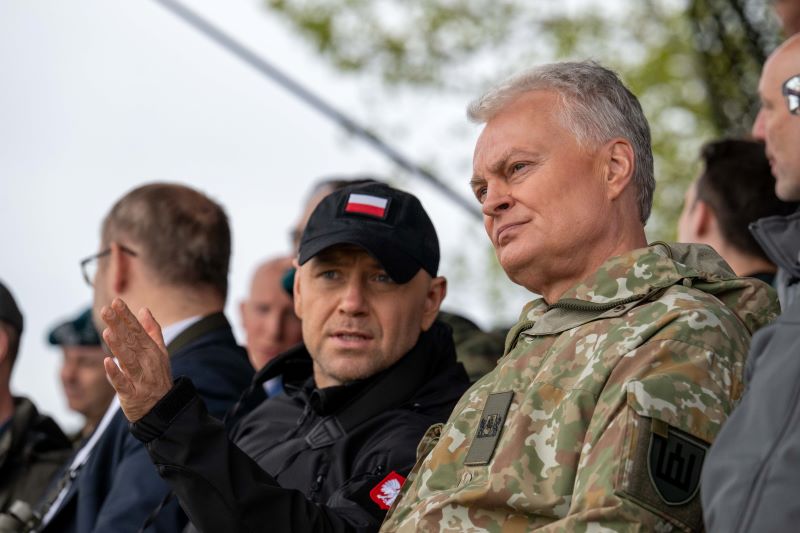
Lithuanian President Gitanas Nausėda categorically denies that the secret CIA prison Lithuania facility operated in the country, even as Lithuania pays hundreds of thousands of euros in damages to former detainees tortured at the site. Meanwhile, Foreign Minister Kęstutis Budrys has urged investigators to “follow the money” to uncover the truth, while prosecutors cite a lack of evidence to move forward.
For years, journalists and the public have demanded answers about the secluded facility in the forest near Vilnius, but officials continue to offer a conflicting array of explanations.
The following is a compilation of known facts about the site. It examines the structure of “Site Violet,” the shifting explanations offered by Lithuanian authorities, the destination of the CIA’s classified funds, and the reasons this issue has returned to the headlines.
How the CIA Prison Lithuania Was Exposed


The story first broke on August 20, 2009, when the US television network ABC News reported that Lithuania had provided the CIA with a secret facility to detain and interrogate up to eight high-value Al-Qaeda suspects. On November 18, 2009, ABC News identified the exact location as a former riding academy in the quiet village of Antaviliai, located 20 kilometers northeast of Vilnius.
As the scandal grew, the Lithuanian Parliamentary Committee on National Security and Defense (NSGK) launched an inquiry. On December 22, 2009, the committee officially acknowledged that Lithuania had established the necessary conditions for secret CIA facilities to operate, and confirmed that US intelligence aircraft had repeatedly landed in the country without undergoing customs inspections.
Major international confirmation came in December 2014, when the US Senate released a heavily redacted report on CIA torture. Although country names were blacked out, human rights advocates and experts matched flight logs and other details to confirm that “Site Violet” referred to the complex near Vilnius.
The European Court of Human Rights (ECHR) settled the legal dispute on May 31, 2018. The ECHR ruled that a secret prison had indeed operated in Lithuania between 2005 and 2006, finding the country in violation of the European Convention on Human Rights, which prohibits torture, and ordering it to pay compensation to the victims.
Inside the CIA Prison Lithuania Near Vilnius
According to declassified data, US Senate reports, and ECHR court records, the Antaviliai facility was constructed as a “building within a building” under strict secrecy.
In March 2004—the exact month Lithuania officially joined NATO—a US shell company named Elite LLC, registered in Delaware, purchased the private riding academy and a small cafe. The CIA soon began a major reconstruction project. Workers built a thick concrete wall inside a massive steel hangar, creating a fully isolated two-story structure. To avoid hiring local contractors, prefabricated elements and building materials were flown in directly on US aircraft.
The ECHR case files and the Senate report show that the facility contained about ten windowless, soundproof rooms with carpeted walls. The complex was equipped with a backup generator, an independent water supply system, and an electrical grid modified to the US 110-volt standard.
The secret facility operated from September 2004 to March 2006. Logistics relied on private planes chartered by the CIA under the guise of civilian flights. These aircraft landed at Vilnius International Airport or the Šiauliai military airbase. Under direct orders from the State Security Department of Lithuania (VSD), these flights bypassed border and customs controls, and local officials were strictly forbidden from approaching the aircraft.
Detainees and Interrogation Methods

International investigators and US Senate data estimate that “Site Violet” could hold up to eight high-value detainees at a time. To date, the Strasbourg court has legally established the detention of at least three individuals at the Antaviliai facility:
- The Case of Abu Zubaydah (May 31, 2018): The court ruled that a secret CIA facility, known as “Detention Site Violet” in Antaviliai near Vilnius, operated in Lithuania from February 2005 to March 2006. Lithuania was found guilty of violating European Convention articles prohibiting torture and unlawful detention. Zubaydah, a Saudi citizen, was considered by the US to be a key Al-Qaeda logician.
- The Case of Mustafa al-Hawsawi (January 16, 2024): The ECHR issued another similar ruling against Lithuania, awarding €100,000 in compensation to the Saudi citizen for unlawful detention and mistreatment at the facility between 2005 and 2006. US authorities identify Mustafa al-Hawsawi as a high-ranking Al-Qaeda member and a primary financial facilitator for the September 11, 2001, attacks.
- The Case of Abd al-Rahim al-Nashiri (July 2026): The ECHR ruled against Lithuania, establishing that the CIA held another terror suspect in the country. US authorities regard him as one of Al-Qaeda’s most dangerous high-ranking members and the chief architect of the 2000 USS Cole bombing.
According to ECHR case documents and the Senate report, detainees were subjected to “enhanced interrogation techniques.” They were held in conditions of complete sensory deprivation and solitary confinement, kept in leg irons, and exposed to continuous loud noise and bright light. In his appeals, al-Hawsawi also reported regular physical abuse and severe migraines that began after his interrogation in Lithuania.
Key Decision-Makers: Who Kept the Secrets?
The secret facility was established and operated between September 2004 and March 2006. A look at the key political and security figures leading Lithuania during this period provides critical context.
When the international scandal broke in 2009 and the Lithuanian Seimas launched a parliamentary inquiry, these four key officials were called to testify. Their testimonies converged on a single narrative: “We knew nothing about this, we were misled by the intelligence services, and there was no prison in Lithuania.”
Testimony from Top Officials of the 2004–2006 Period:
- Valdas Adamkus (President of Lithuania, July 2004 – July 2009): His second term covered the facility’s entire operational period, though the initial deal with the CIA was negotiated in early 2004 under acting president Artūras Paulauskas. Adamkus repeatedly denied any knowledge, calling the reports “complete news to me.” During parliamentary hearings, he testified that he questioned intelligence chiefs upon hearing initial rumors but was assured no such facility existed. He later stated: “If people were brought into the country behind my back, that is a crime,” maintaining he would never have authorized a torture site.
- Mečys Laurinkus (Director of the VSD until April 2004): He resigned before the facility opened but was present during initial talks with US officials. Laurinkus admitted that in 2002–2003, the CIA approached him with a “hypothetical” question about hosting “several individuals.” He stated that he refused, citing the illegality of the request, and reported the exchange to then-President Rolandas Paksas. Laurinkus maintained: “While I was head of security, no prisons existed.”
- Arvydas Pocius (Director of the VSD, April 2004 – 2007): The Antaviliai facility was established and flights arrived under his watch. Pocius denied that any detainees were interrogated, asserting that the site was solely an intelligence support center for communications and electronic warfare. He attributed the lack of aircraft inspections to the strict classification of NATO programs, claiming the planes carried communications equipment. When questioned by journalists after entering private legal practice, Pocius declined to comment further, saying: “I have nothing to add to what has been said.”
- Antanas Valionis (Minister of Foreign Affairs, 2000–2006): Valionis claimed that diplomats were excluded from the decision-making loop. He stated that the VSD operated autonomously and did not inform the Foreign Ministry of the CIA flights, as they were handled through closed military and intelligence channels without diplomatic notes.
The Outcome of the Parliamentary Inquiry
Following the hearings, the Seimas committee concluded that VSD leadership, particularly Pocius and his deputy Dainius Dabašinskas, had deliberately misinformed state leaders. This effectively created a “state within a state,” allowing US intelligence to operate without oversight from Vilnius.
Lithuanian officials continue to maintain this version of events. However, the ECHR has emphasized in its rulings that top state officials could not have been unaware of the activities on their territory.
Inconsistencies and Conflicting Official Accounts
When questioned about the events in Antaviliai, Lithuanian authorities and political figures offer a wide range of interpretations. Even following the latest ECHR ruling in July 2026, Vilnius’s official position remains a delicate balance between international law, commitment to its US alliance, and domestic pressure. Their current positions are as follows:
- State Security Department (VSD): Maintains its technical explanation. The agency asserts that the Antaviliai facility was built strictly as an “intelligence support center,” and that secret CIA planes delivered advanced telecommunications equipment rather than detainees. The VSD has not explained why shipping servers and radios required windowless, soundproof cells or the exclusion of customs inspections.
- Dalia Grybauskaitė (President, 2009–2019): Favored a narrative of institutional accountability. In 2009, she acknowledged “indirect suspicions” and called for an apology if the facts were confirmed. She later noted that the inquiry had reached an impasse due to Washington’s refusal to share information.
- Prosecutor General’s Office: Cites a lack of sufficient information. Prosecutors state that the domestic investigation cannot proceed because US partners refuse to respond to inquiries or provide data regarding “Site Violet.”
- Gitanas Nausėda (Incumbent President): States that he fully trusts the findings of Lithuanian agencies, which concluded that no secret US prison for terror suspects existed in the country. He has indicated there is no need to reopen the case or launch new investigations.
A recent statement by Lithuanian Foreign Minister Kęstutis Budrys stands apart from these positions. Rather than focusing on the physical facility, Budrys proposed examining the financial records. He stated: “The massive question regarding the millions that were hidden [redacted in reports] is a matter of honor for Lithuania to answer. We do not have the right to leave it closed.“
The Foreign Minister suggested tracing the funds to identify exactly who received the payments and for what purpose, exploring potential bribes associated with hosting the facility. Why Lithuania has not yet taken this step remains unclear.
Ongoing Investigation of the CIA Prison Lithuania
NEWSROOM IN notes that all the aforementioned detainees of the secret CIA prison in Lithuania remain held at Guantanamo Bay.