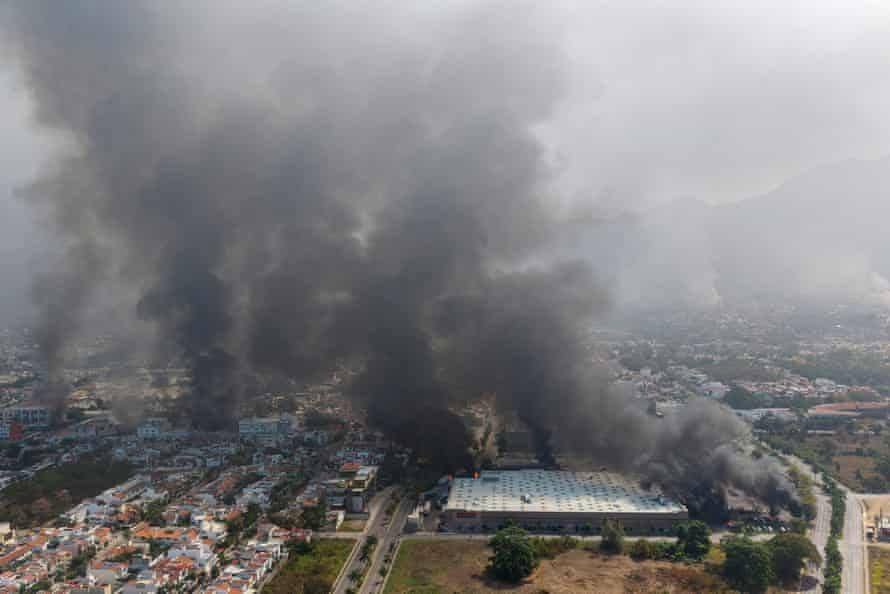
The Mexico cartel war has transformed cities into scenes from a bloody action thriller as brutal violence spills into the streets. Military forces are engaged in open combat with criminal syndicates, while terrified tourists in local hotels share tearful social media videos describing the chaos surrounding them.
The surge in violence follows the killing of El Mencho (Nemesio Oseguera Cervantes), the leader of the ultra-aggressive Jalisco New Generation Cartel (CJNG). He was killed on February 22, 2026, during a high-stakes operation by the Mexican army supported by U.S. intelligence.
Mexico Cartel War: CJNG Retaliation and Reaction
In retaliation for their leader’s death, CJNG militants have declared war on the government. Mass unrest has swept the country, particularly in the state of Jalisco and the city of Guadalajara. Criminal groups have set buses on fire, blocked more than 250 roads, and attacked administrative buildings. Local media report casualties among soldiers, civilians, and cartel members, with at least 30 deaths confirmed so far.
While official reports have not yet detailed the elimination of other high-ranking “lieutenant” level commanders, two cartel members were reportedly captured alive during the operations.
The escalating violence has prompted emergency warnings from foreign governments:
- The United States urged its citizens in several Mexican states to stay indoors. The warning covers Jalisco — which includes Puerto Vallarta, Chapala, and Guadalajara — as well as Tamaulipas, parts of Michoacán, Guerrero, and Nuevo León. U.S. Deputy Secretary of State Christopher Landau praised the operation: “This is a major event for Mexico, the U.S., Latin America, and the world. I watch the scenes of violence in Mexico with great sadness and concern. It is no surprise that the bad guys respond with terror. But we must never lose our composure.”
- Canada: The Ministry of Foreign Affairs warned of violence and roadblocks in Jalisco and noted the implementation of a lockdown in Puerto Vallarta, advising Canadians to maintain a low profile. Air Canada has suspended all flights to Puerto Vallarta.
Cartel War: Influence Map as of Early 2026
In addition to fighting the government, criminal groups have launched a fierce internal struggle to redraw territory. NEWSROOM IN has compiled an up-to-date map of cartel influence based on open-source intelligence:
- Jalisco New Generation Cartel (CJNG): Despite the loss of its leader, the cartel remains the most powerful. It is numerous and heavily armed. The 60-year-old El Mencho was one of Mexico’s most wanted criminals. According to the U.S. State Department, he controlled the country’s largest trafficking operations for cocaine, heroin, methamphetamine, and fentanyl. CJNG is blamed for thousands of murders of rival gang members and Mexican law enforcement officers.
- Sinaloa Cartel: This group has been significantly weakened by internal rifts between the “Los Chapitos” faction (sons of El Chapo) and loyalists of “El Mayo” Zambada. However, the cartel is expected to exploit the chaos within CJNG to regain control over the West Coast.
- Santa Rosa de Lima Cartel (CSRL): A localized but extremely violent group in Guanajuato and blood rivals of CJNG. They may use their competitor’s weakness to reclaim lost territory and control illegal fuel siphoning (huachicoleo).
- Cárteles Unidos and Los Viagras: An alliance of regional groups in Michoacán created specifically to halt CJNG expansion. Following recent events, they are actively mobilizing forces and strengthening armed checkpoints.
- Juárez Cartel (and their armed wing, La Línea): They maintain tight control over the key border city of Ciudad Juárez, fighting a long-term war of attrition for smuggling routes into Texas.
- Regional Groups: The Gulf Cartel, Northeast Cartel, and La Familia Michoacana hold control over strategic logistical corridors on the eastern U.S. border and along the Gulf of Mexico.
Mexico Cartel War: Balance of State and Mafia Power
The scale of recent street battles has reignited the debate over the actual balance of power between the state and organized crime. On one side stands the regular army. According to official data, Mexico’s active military personnel numbers approximately 387,000. This figure, including land, air, and naval forces, makes it one of the largest militaries in Latin America. However, experts warn that in urban warfare, numerical superiority alone does not guarantee dominance.
The military faces a massive “shadow army.” Security research indicates that the total number of cartel members in Mexico is estimated between 150,000 and 200,000, with some analytical forecasts suggesting it could be as high as 250,000. Experts note an important distinction: these statistics include not only heavily armed hitmen (sicarios) but also a vast network of logisticians, street lookouts (halcones), and financial facilitators who keep the syndicates running.