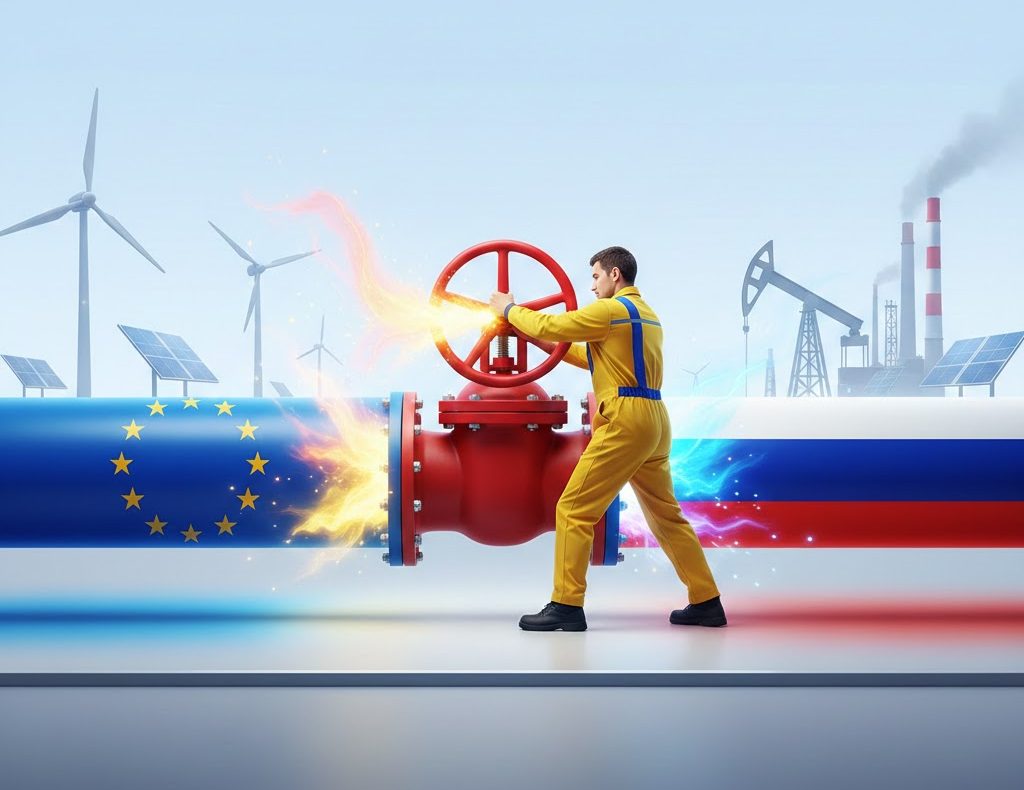
The European Council and the European Parliament have reached a preliminary agreement on a regulation that will gradually prohibit the import of both Russian gas and liquefied natural gas (LNG).
Although these arrangements are still preliminary, Lars Aagaard, Denmark’s Minister for Climate, Energy, and Utilities (the EU Presidency country), called the decision “a great victory” and a critically important step toward permanently ending energy dependence on Moscow.
Key Deadlines: When to Expect the Full Ban (Russian Gas and LNG Phase-out Dates)
The new rules establish clear termination dates for all Russian gas supply contracts:
| Type of Gas | Contract Type | Deadline for Ban |
|---|---|---|
| Pipeline Gas | Long-term Contracts | No later than November 1, 2027 |
| Liquefied Natural Gas (LNG) | Long-term Contracts | No later than January 1, 2027 |
A transitional period is provided for short-term contracts: supplies of Russian LNG will cease starting April 25, 2026, and pipeline gas will cease starting June 17, 2026.
How Will This Work?
To ensure these restrictions are enforced, the EU is implementing strict controls:
☛ A special authorization system will be introduced for each delivery (applications must be submitted at least one month in advance).
☛ Serious penalties are mandated for violations of the new rules, affecting both companies and individuals.
☛ All EU member states are required to develop and submit national plans for finding alternative energy suppliers to achieve a complete phase-out of Russia.
What About Oil?
NEWSROOM IN notes the overall picture regarding EU purchases of Russian oil and gas.
Following the start of the full-scale invasion of Ukraine (February 2022) and the introduction of sanctions, EU spending on Russian energy resources has sharply decreased compared to the peak year of 2021 and the first half of 2022.
| Period | Total Amount Spent by the EU on Oil and Gas from Russia | Note |
|---|---|---|
| 2021 | Approximately €163.6 billion (Total imports of goods from Russia) | Energy commodities made up the overwhelming share. |
| 2023 | Approximately €23 billion | European Commission estimate for overall energy imports. |
| 2024 | Approximately €21.3 billion | German Federal Statistical Office data on oil and gas imports. |
An important nuance regarding 2024: The €21.3 billion figure for 2024 demonstrates the massive reduction in volumes, as total imports from Russia before the war (in 2021) were roughly 7–8 times higher (€163.6 billion).
Focusing only on oil, the reduction has been the most radical. Due to the EU embargo on Russian oil—introduced following Russia’s invasion of Ukraine—and the G7 price cap, Russia’s share of EU oil imports has dropped from approximately 29% in 2021 to just 2–3% in 2024.
Therefore, while the EU spent tens of billions of euros specifically on oil in 2021, by 2024, the bulk of the remaining payments (€21.3 billion) consists of gas (especially LNG) and oil supplied via the Druzhba pipeline to countries that received sanction exemptions (such as Hungary and Slovakia).