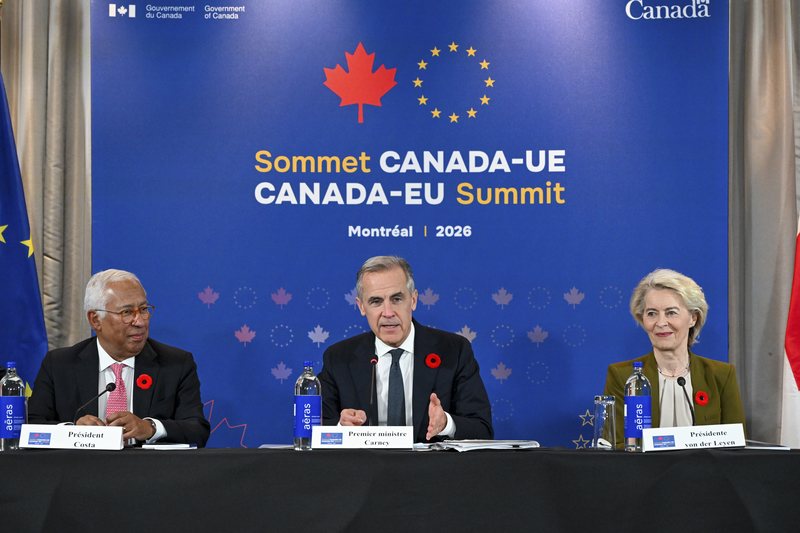
The two-day EU-Canada summit held in Montreal in late October 2026 was Ottawa’s most prominent bid to move out from the geopolitical shadow of the United States. Prime Minister Mark Carney and European Commission President Ursula von der Leyen announced the launch of an “Alliance for the Future” initiative. The partnership focuses on three core pillars: economics, security, and joint cooperation within international institutions like the United Nations. Both sides agreed to draft a concept of “ever closer association” by the 2027 summit, positioning it just one step away from full membership status.
The Economics of Technological Sovereignty
The new alliance extends far beyond traditional import and export trade. A central outcome of the summit was a European Investment Bank (EIB) framework agreement to inject capital into Canada’s critical minerals extraction sector, including lithium, cobalt, and nickel. The EU secures a guaranteed resource base bypassing China, while Canada obtains funding to expand the industry.
Both parties officially began linking business instant payment systems, initiated laying a new transatlantic internet cable, and integrated Canada into the European High Performance Computing (EuroHPC) network. Ottawa has already allocated $1.6 billion to artificial intelligence firm Cohere to develop products for the combined market.
The partners also agreed to explore the feasibility of long-term Canadian liquefied natural gas (LNG) exports to Europe. Von der Leyen stated that the partnership aims to build sovereignty protecting allied economies from external coercion.
Security
In a joint statement, Canada and the EU outlined the following steps to jointly respond to citizen security threats:
- Strengthening cybersecurity: The plan includes expanding intelligence sharing on cyber threats, coordinating incident response, and increasing critical infrastructure resilience. Special focus will be placed on AI-related threats, including automated attacks, as well as the responsible use of AI to prevent cyberattacks.
- Maritime security: Canada and the EU agreed to strengthen the security of critical maritime and subsea infrastructure.
- Protecting democracy and countering disinformation: A dedicated cooperation framework will be developed to bolster democratic resilience and protect the information space. As part of this effort, a new dialogue on foreign information manipulation and interference (FIMI) was launched to shift from reactive to proactive measures. Given the lack of concrete specifics, it will likely function primarily as another bureaucratic platform.
- Law enforcement cooperation: Both parties pledged to increase operational and intelligence sharing between police, border control, and counternarcotics agencies. Further expansion of judicial cooperation is also planned.
- Crisis and disaster preparedness: The declaration includes plans to improve joint preparedness for future pandemics as well as natural and man-made disasters, including cooperation in combating wildfires with Canadian firefighting aircraft.
Joint Action in International Institutions
A separate section focuses on engagement within international institutions, centering on the defense of the multilateral order:
- UN reform: Canada and the EU co-sponsor the Partners for Multilateralism (P4M) initiative and plan to advance the UN80 initiative to make the United Nations more efficient, cost-effective, and adaptable.
- International law and courts: The partners committed to upholding the principles of the UN Charter and the UN Convention on the Law of the Sea (UNCLOS). The document affirms unconditional support for the International Criminal Court (ICC) and expresses deep regret over sanctions imposed against it by the United States.
- Economic and political forums: Ottawa and Brussels will expand coordination within the G7 and G20. The statement also stresses the urgent need to reform the World Trade Organization (WTO) to adapt it to current economic realities.
- Environmental initiatives: The allies plan to present a united front in UN climate talks, seeking ambitious outcomes at the upcoming UNFCCC COP31 and BBNJ COP1 conferences, while backing UN Environment Assembly (UNEA) resolutions against plastic pollution.
Pushback Against the EU-Canada Summit Alliance
The push for closer ties faced resistance both within the EU and Canada, as well as from the United States.
☛ Despite good relations with Canada, German Chancellor Friedrich Merz insisted on removing the term “associate membership” (or “associate member”) from the summit’s final declaration. Merz had originally proposed the concept in spring 2026 specifically for Ukraine as a two-stage interim step toward full EU accession. When von der Leyen sought to apply the term to Canada, which is geographically and legally ineligible for EU membership, Merz rejected what he viewed as a dilution of the designation. The leaders of France and Italy, along with several European diplomats, supported his stance.
☛ Within Canada, Conservative Party opposition leader Pierre Poilievre criticized the summit, calling it “a grand theatrical meeting to sign a pile of meaningless declarations full of big words.”
On social media, Poilievre wrote that such events will not lower anyone’s “mortgage or grocery bill.” He also opposed closer alignment with Brussels and the idea of associate EU membership for Canada, declaring: “We will never be the 51st state of the United States, but we will never be the 28th member state of the European Union either.”
☛ Criticism from the United States was even sharper. U.S. President Donald Trump previously described Canada’s move toward the EU and the associate membership idea as “ridiculous,” viewing closer ties between Ottawa and Brussels as an unfriendly or “hostile” act.