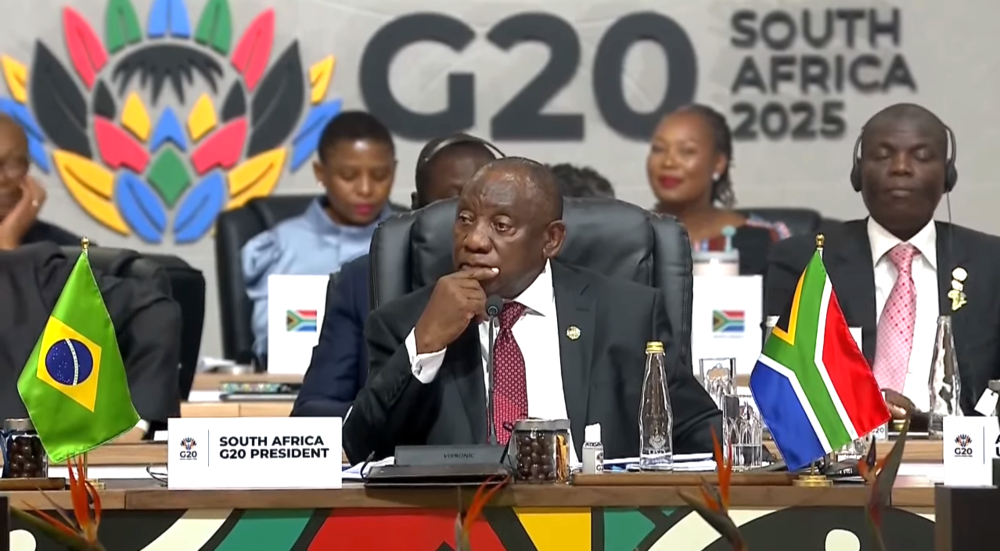
Leaders at the G20 summit in South Africa adopted a joint declaration with a strong focus on Global South issues, sustainability, fairness, and unlocking Africa’s potential.
NEWSROOM IN has examined the declaration and explains its implications for our daily lives (in both a short and extended version):
Now We Are All Partners


The essence of the G20 South Africa summit can be distilled into one core idea: wealthy nations have finally committed to revising the rules of the game that have worked against poorer countries for decades. The main slogan is “No Isolation”. This signifies that if a country suffers from poverty, it will eventually impact everyone, making it a global interest to provide assistance. For the first time, the G20 declared that borders cannot be changed by force and that they oppose any nation remaining vulnerable to external adversaries.
The most significant changes will concern money and employment. If a country is burdened by debt, the G20 pledges that these debts will be restructured to ensure the state retains funds for healthcare, education, or infrastructure, rather than solely for interest payments. Moreover, if you live in Africa, your country should learn to process its raw materials domestically (beneficiation at the source) instead of merely extracting and exporting them. This means creating new, high-paying jobs at home, not just draining resources.
Additionally, the G20 promised that Africa should become a hub for AI innovation, rather than just a user of foreign applications. And if your region is experiencing droughts or floods, the G20 vowed to expedite funding for early warning systems and recovery efforts. Essentially, the declaration is a promise from world leaders that your region will no longer simply be a consumer of resources and technologies but will become a full-fledged partner, creating its own prosperity and security.
Here is a more extended version of the declaration:
Geopolitics and Multilateral Cooperation (Ubuntu Philosophy)

☛ Ubuntu as Foundation: Leaders recognized the Ubuntu philosophy (“I am because we are”) as a guiding principle, emphasizing the interconnectedness of the global community and the necessity of multilateral cooperation.
☛ Condemnation of Conflicts and Wars: Leaders expressed concern over rising geopolitical instability and conflicts, reaffirming commitment to international law and the UN Charter.
☛ Inadmissibility of Changing Borders by Force: It was underscored that all states must refrain from the threat or use of force for territorial acquisition against the sovereignty or political independence of any state.
☛ Pursuit of Peace: A readiness was declared to work towards a just, comprehensive, and lasting peace in Ukraine, Sudan, the DRC, and other conflict zones.
Economic Justice and Development Financing


☛ Critical Debt Burden: It was acknowledged that high debt levels are a major impediment to inclusive growth, particularly in low- and middle-income countries (especially in Africa), limiting their ability to invest in health and education.
☛ Support for the G20 Common Framework: Commitment to strengthening the implementation of the G20 Common Framework for debt restructuring was reaffirmed, along with enhancing debt transparency from all stakeholders, including private creditors.
☛ Reducing Capital Costs: Support was expressed for reviewing the IMF/World Bank Debt Sustainability Framework for Low-Income Countries (LIC-DSF) to more effectively address vulnerabilities.
Africa’s Priorities: A Revolution in Global Economic Participation

☛ Critical Minerals and Beneficiation: The G20 Critical Minerals Framework, a voluntary plan, was adopted to become a driver of prosperity and sustainable development. The goal is to ensure that critical minerals act as a catalyst for value addition (on-site processing) rather than merely raw material exports.
☛ Artificial Intelligence (AI) for Africa: The AI for Africa Initiative, launched under South Africa’s presidency, aims to position Africa as a source of innovation, not just a consumer of AI, by facilitating access to computing power, talent training, and infrastructure development.
☛ Industrial Policy: The Voluntary and Non-Binding G20 High-Level Principles on Sustainable Industrial Policy were adopted to help developing countries (especially African nations) better integrate into global manufacturing supply chains.
Energy Transition and Resilience


☛ Africa’s Energy Crisis: It was highlighted that over 600 million Africans lack access to electricity, and approximately 2 million people die annually due to the absence of clean cooking solutions.
☛ Financing a Just Transition: The G20 will work to facilitate low-cost financing for developing countries (including concessional financing, blended finance, and risk-mitigation mechanisms) for their transition to low-carbon emissions.
☛ Strengthening Disaster Resilience: The need to build resilience to natural disasters (floods, droughts, wildfires), exacerbated by climate change, was recognized. Leaders called upon the global community, including international financial institutions and the private sector, to increase investments in disaster prevention, adaptation, and recovery.