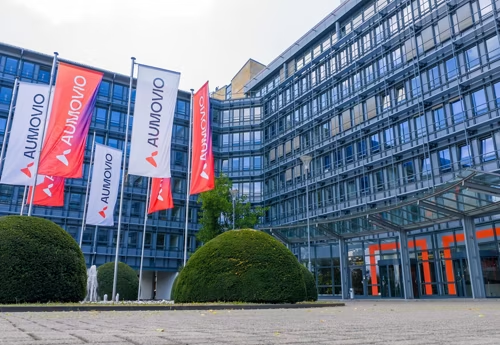
German automotive components manufacturer Aumovio Lithuania (formerly Continental) is closing its major factory in Lithuania. The plant has operated in the Kaunas Free Economic Zone since 2019. Its closure marks a significant blow to the Lithuanian economy, resulting in the loss of approximately 800 high-skilled jobs, the write-off of a 190 million euro investment, and the loss of millions in potential tax revenue.
The decision has prompted government economic officials and the business community to address the deteriorating investment climate and the reasons why Lithuania is losing large-scale international projects.
Official reasons for the Aumovio Lithuania closure
Aumovio attributed its departure to a global decline in demand for automotive components, inefficient use of production capacity, and increasingly complex supply chains.
Lithuanian officials, including Prime Minister Inga Ruginienė, stated that the issue stems from broader European Union bureaucratic processes rather than local factors. Economy Minister Edvinas Grikšas confirmed the ministry was prepared to offer any concessions to keep the plant, but these efforts failed to change the corporation’s global business logic.
Mindaugas Sinkevičius, leader of the ruling Social Democrats, noted that the investor left without entering negotiations. “If there were a list of requirements or wishes for our state—complete these five points and we stay—I have no doubt it would have been done. But this is a very clear change in the company’s strategic direction that affects more than just Lithuania,” the politician said.
Sinkevičius argued that the Ministry of Economy and the agency Invest in Lithuania must shift focus from attracting new companies to retaining existing ones. He called for proactive engagement with businesses to address their needs and respond to signs of dissatisfaction with the business climate.
Hidden drivers of capital flight
Corporate decisions are based on a complex set of factors where taxes and costs are only part of the calculation. NEWSROOM IN identified several reasons behind the decision to close the Kaunas plant:
- The crisis in the German auto industry. Aumovio produces components for major European, primarily German, car manufacturers. Volkswagen, BMW, and Mercedes are facing a severe crisis as sales decline due to competition from cheap Chinese electric vehicles. The transition to green technologies is also reducing margins. The Kaunas plant effectively has no market for its production volume in Europe.
- EU ESG bureaucracy. Lithuanian leadership pointed to European regulations. Strict environmental directives, including carbon footprint taxes and recycling requirements, make production within Europe unprofitable. Aumovio finds it more cost-effective to move production to North Africa, Latin America, or Asia, where European compliance standards do not apply, and then import the finished parts.
- Disruption of the Eastern European logistics hub. The Kaunas plant relied on efficient logistics. Geopolitical events have cut the Baltic states off from Eastern markets in Russia and Belarus while complicating land transit. The resulting longer transport routes have made exporting from Lithuania to other global regions too expensive.
- The “frontline state” risk factor. Factories are physical assets requiring 10- to 20-year planning horizons. Public warnings from Lithuanian politicians and intelligence services regarding potential military threats may mobilize domestic society, but they serve as alarms for corporate risk managers. Constant military rhetoric labels the region as a high-risk zone, prompting investors to move physical assets further west.
A broader trend: Other market exits in 2024–2026
The departure of Aumovio is part of a wider trend. Over the last two years, several international companies have announced closures or significant staff reductions in Lithuania as part of global cost optimizations:
- TransUnion. The American credit analytics company is closing its shared services center in Lithuania, cutting approximately 240 jobs. Functions are being moved to other global centers to reduce costs.
- Transcom Worldwide. The Swedish outsourcing giant carried out mass layoffs at its Vilnius office in late 2025, significantly reducing its market presence.
- EPAM Systems. The software developer implemented some of the largest staff cuts in the Lithuanian IT sector. This reflects a broader trend of shrinking presence for Belarusian IT firms that had previously relocated to the country en masse.
- Shift4 Payments. The American fintech company reduced its Vilnius staff in spring 2025 as part of global optimization.
- The company Bifinity (the Lithuanian branch of Binance) was a major contributor to the national budget. Since 2022, it paid approximately 111 million euros in taxes. However, media reports indicate that by early 2026, the crypto giant began licensing processes in Latvia and other jurisdictions.
- Bifinity (Binance). The Lithuanian division of the crypto exchange was a significant revenue source for the state. Since 2022, it paid about 111 million euros in taxes. By early 2026, the company reportedly began moving toward licensing in Latvia and other more pragmatic jurisdictions.
A shifting economic profile
The exit of Aumovio, Binance, TransUnion, and other tech giants indicates a change in the structure of global risks rather than an economic collapse.
The Lithuanian government offered various incentives to these businesses. However, national preferences cannot compensate for disrupted global logistics, European bureaucracy, or the psychological discomfort of operating in a region with high geopolitical tension.
Lithuania’s economy is undergoing a transformation. While losing civilian manufacturing and fintech, the country is attracting new industries. Between 2024 and 2026, defense giant Lockheed Martin, Commerzbank, and bicycle manufacturer Pon.Bike announced entries into the Lithuanian market. Businesses seeking cheap logistics are being replaced by corporations whose models are tied to security infrastructure and the current realities of the European continent.