Eurostat has released a comprehensive report on economic and physical security across the European Union. At the close of 2025, 29.2% of the EU population lacked sufficient savings to independently handle unexpected expenses.
Unexpected Expenses by Country: Stability to Crisis
The statistics reveal a stark wealth divide across member states. Greece faces the most severe situation, where more than half of the population (50.5%) cannot withstand financial shocks. Latvia (43.7%) and Bulgaria (42.4%) follow closely behind. Citizens in these nations remain the most exposed to inflation and unexpected domestic emergencies.
The Netherlands demonstrated the highest financial resilience, with only 15.3% of residents struggling to handle emergency costs. Malta and Czechia followed as the next most financially secure countries, each at 18.7%.
Eurostat analysts emphasize a direct link between financial stability and overall quality of life. Economic security, along with the ability to pay recurring bills on time, forms a fundamental sense of safety. In struggling countries, a lack of savings leads to increased social tension and reduced consumer spending, which further dampens local economies.
Physical and Economic Safety
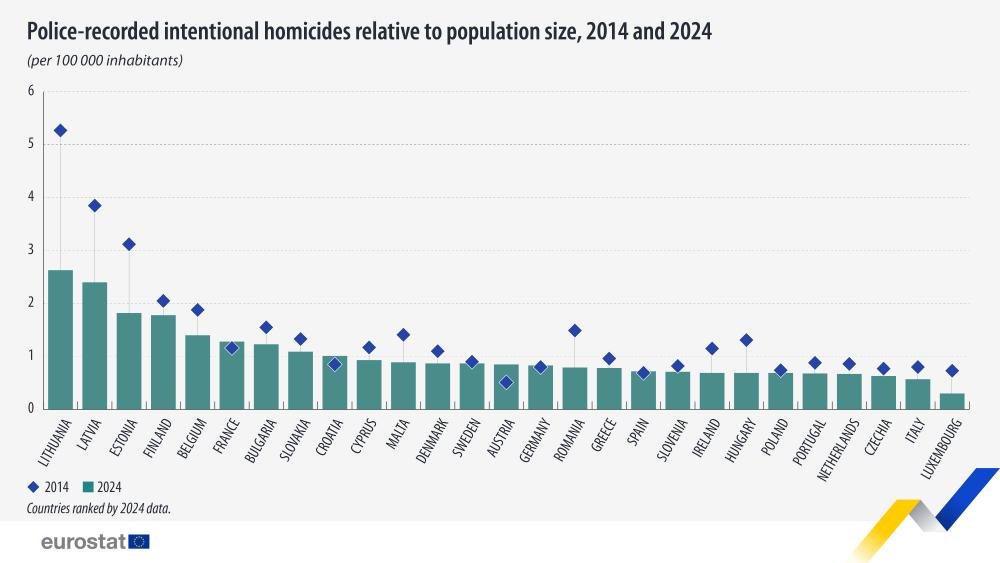
Beyond financial strain, the agency measured physical security by examining intentional homicide rates. In 2024, Lithuania recorded the highest rate in the EU at 2.63 homicides per 100,000 residents, despite cutting its figure by more than half over the past decade. Latvia (2.40) and Estonia (1.82) posted the next highest rates. The safest EU nations were Luxembourg (0.30), Italy (0.57), and Czechia (0.63), which achieved strong results across both economic and physical criteria.
Survival Dynamics
NEWSROOM IN notes that Eurostat previously recorded an even tougher financial situation across the bloc. In 2024, exactly 30% of Europeans could not pay unexpected bills. The slight decline to 29.2% points to a minimal and fragile stabilization following consecutive economic shocks. While Czechia combines high economic and physical safety, Latvia consistently ranks near the bottom in both metrics, showing that the European Union remains sharply divided into zones with fundamentally different levels of social security.