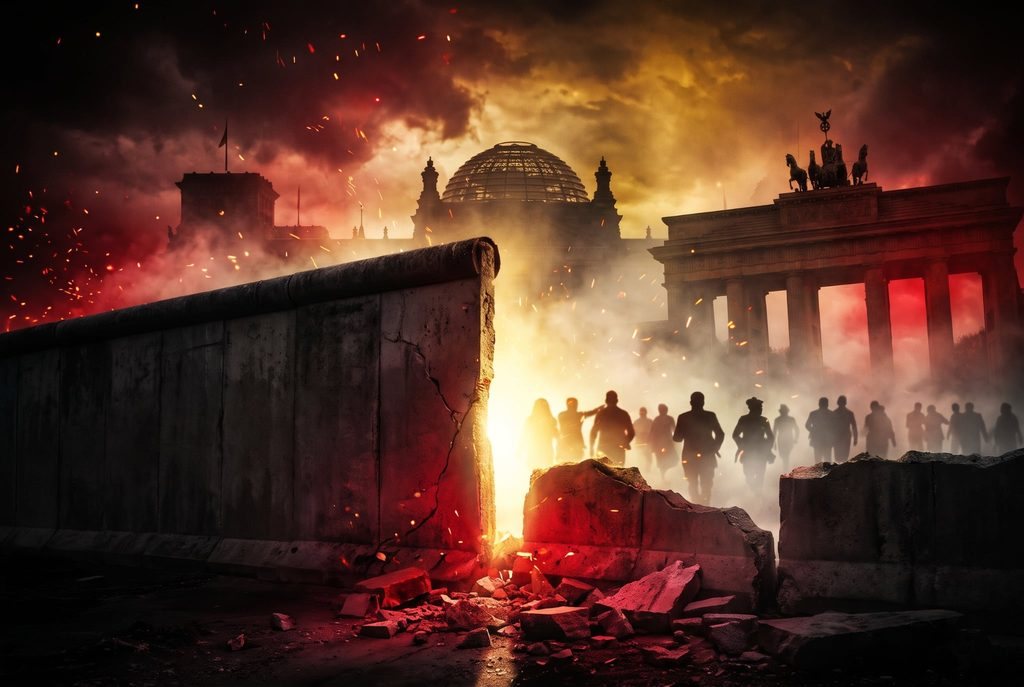
In German history, November 9 is officially designated as the “Day of Fate” (German: Schicksalstag). This specific calendar date repeatedly served as a turning point that transformed the political and social order of the nation. For Germany, November 9 brought moments of democratic breakthrough alongside national tragedies. NEWSROOM IN examines the events tied to this date:
1848: The Execution of Robert Blum
On this day, Robert Blum (Robert Blum), a leader of the German democratic movement, was executed by firing squad in Vienna. His death marked the beginning of the end for the March Revolution (Revolutions of 1848 in the German states).
Notable detail: Austrian authorities executed Blum despite his status as a member of parliament and his diplomatic immunity. His reported final words, “I die for freedom,” established him as a martyr of the revolution, and his name was used as a recognition code among underground democratic groups.
1918: Proclamation of the Republic
Kaiser Wilhelm II abdicated, ending the German monarchy. Social Democratic leader Philipp Scheidemann proclaimed the Weimar Republic from a window of the Reichstag building in Berlin.
Notable detail: Scheidemann acted without the approval of his party leadership, rushing to the window to preempt the left wing. Just two hours later, communist leader Karl Liebknecht proclaimed a “Free Socialist Republic” modeled on Soviet Russia from a balcony of the Berlin Palace, but Scheidemann’s declaration had already carried the day.
1923: The Beer Hall Putsch in Munich
Adolf Hitler and his followers launched an armed coup attempt known as the Beer Hall Putsch. Bavarian police quickly suppressed the uprising, and the Nazi Party was temporarily banned.
Notable detail: When police fired on the putschists, Hitler dislocated his shoulder as he fell to the pavement and fled the scene in a car. Police arrested him several days later at a friend’s villa, where he was hiding in an attic behind a wardrobe.
1925: Formation of the SS (Schutzstaffel)
The Nazi Party officially established the Schutzstaffel security units, which eventually served as the main apparatus for state terror and the Holocaust under the Third Reich.
Notable detail: The organization started as an eight-man squad known as the Saal-Schutz (Hall Defense). Its initial role was limited to ejecting disruptive attendees from beer halls and meeting rooms where Hitler spoke.
1938: Kristallnacht
The Nazi regime carried out its first coordinated, state-sponsored pogrom against Jewish communities across Germany, annexed Austria, and the Sudetenland. Hundreds of synagogues were set on fire, thousands of businesses were destroyed or ransacked, and more than 1,300 people were killed.
Notable detail: Berliners initially coined the term “Kristallnacht” (Night of Broken Glass) in reference to the shattered storefronts, and Nazi propaganda quickly adopted the phrase. Contemporary German historians largely avoid this title in favor of the “November Pogroms,” arguing that the poetic phrasing obscures the scale of the state violence and loss of life.
1967: Student Protests in Hamburg
Social unrest grew in West Germany throughout 1967. During summer protests against the visit of the Shah of Iran, a police officer shot student Benno Ohnesorg dead, accelerating student radicalization. Demonstrators challenged the presence of former Nazi-era officials in courts, universities, and federal administration. This confrontation reached a flashpoint at the University of Hamburg during an official convocation on November 9.
As faculty filed into the hall in traditional academic robes, two students, Detlev Krauſeneck and Björn Pätzoldt, stepped in front of the procession and unfurled a banner reading: “Under the talars—the musty odor of 1,000 years” (Unter den Talaren – Muff von 1000 Jahren). Painted in a garage the previous night, the rhyming slogan quickly spread nationwide.
Notable detail: Theology professor Eggert Wilms reacted by trying to stomp on the banner, shouting at the students: “You all belong in a concentration camp!” The outburst appeared to confirm the demonstrators’ accusations that authoritarian attitudes remained entrenched in the university system. The incident intensified demands for denazification across West German institutions.
1989: The Fall of the Berlin Wall
On this day, the Berlin Wall opened. The border separating the city and dividing families for nearly three decades gave way, clearing the path to the end of the Cold War divide in Europe.
Notable detail: The immediate opening stemmed from a communication misstep. East German Politburo member Günter Schabowski delivered a live press conference on updated travel guidelines without reading the briefing in detail beforehand. Asked when the new rules took effect, Schabowski shuffled his notes and answered: “As far as I know… immediately, without delay.” Thousands of East Berliners headed to crossing points after watching the broadcast, leaving border guards with no clear orders except to open the checkpoints.
1990: Good-Neighborliness Treaty with the USSR
Helmut Kohl and Mikhail Gorbachev signed the Good-Neighborliness Treaty, which established the external framework and security relations for a reunified Germany.
Notable detail: The agreement followed informal bilateral talks between the two leaders. Chancellor Kohl hosted Gorbachev in his home region of Rhineland-Palatinate, serving traditional local dishes during off-the-record meetings that helped resolve difficult security issues surrounding German reunification.
November 9: Remembrance Instead of Celebration
Although the opening of the Berlin Wall on November 9, 1989, stands as a major achievement in modern German democracy, the date was not designated as the country’s national holiday. The historical contrast between the events made celebration problematic, as the nation could not hold festivities on the same date it commemorated the victims of the 1938 anti-Jewish pogroms.
German authorities instead designated October 3 as German Unity Day. November 9 remains an occasion for state remembrance, with ceremonies nationwide focusing on historical responsibility, democratic norms, and the rejection of extremism.