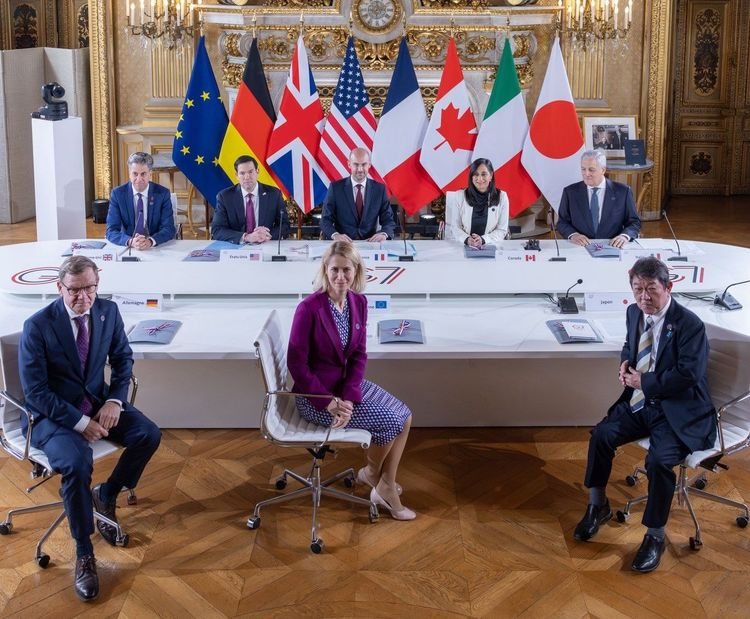
The G7 Paris meeting, held on November 9 and 10, 2026, was marked by open diplomatic clashes rather than consensus. Chaired by French Foreign Minister Jean-Noël Barrot, the allies attempted to paper over deep divisions between Donald Trump’s U.S. administration and European leaders. Key disputes centered on the legitimacy of the International Criminal Court (ICC), negotiations to end the Russia-Ukraine war, sanctions against Iran, and artificial intelligence regulation.
Open Conflict: Rubio vs. Kallas Over the ICC
The most public clash at the summit erupted over the International Criminal Court. U.S. Secretary of State Marco Rubio sharply criticized the ICC for issuing arrest warrants for Israeli leaders. He stated that Washington would seek the court’s dissolution if it does not “recognize its mistake.” According to Rubio, the ICC overstepped its authority by claiming jurisdiction over citizens of countries that have not ratified the Rome Statute.
“Today it is Netanyahu, tomorrow it could be an American. The bottom line is we will not tolerate any American servicemember or military commander facing trial in some illegitimate body that we are not members of,” Rubio said.
In response, EU foreign policy chief Kaja Kallas defended the court, emphasizing that the EU fully supports it. She described the ICC as “the last hope for justice” when national courts fail to act. “The International Criminal Court is not against individual countries. It is actually against war crimes,” Kallas told reporters.
Addressing European blocking regulations against U.S. sanctions, Kallas said the EU is working “on alternative options” that will “allow the International Criminal Court to continue functioning.”
The exchange remained a trade of blunt declarations, leaving both sides entrenched without common ground.
Iran Deadlock
Discussing the Middle East, Rubio indicated that the United States would continue to inflict severe economic damage on Iran, but added that major military operations are “not necessary.” The Secretary of State described direct diplomatic engagement with Tehran as unproductive, calling Iranian demands “not only unacceptable, but in some cases outrageous, ridiculous, and completely unrealistic.”
German Foreign Minister Johann Wadephul warned the U.S. against military strikes, saying military escalation is unacceptable.
Rubio’s comments on contacts with Iran were likely aimed at the new E4–R4 diplomatic format in Istanbul, established in late October 2026. NEWSROOM IN notes that foreign ministers from eight European and Middle Eastern and Asian nations—Turkey, Saudi Arabia, Egypt, Pakistan, Germany, France, the United Kingdom, and Italy—agreed to work together outside traditional UN channels to address the maritime logistics crisis and prevent a wider war in the Middle East.
The creation of the format drew caution in Washington, where moves toward regional control were seen as a challenge to traditional U.S. dominance. Portions of the U.S. foreign policy establishment viewed separate talks between key allies and Tehran as a dangerous precedent.
Fallout From the Korean Dispute
On the sidelines of the G7, officials addressed the recent diplomatic friction between Kyiv and Seoul over North Korean prisoners of war. Ukrainian Foreign Minister Andrii Sybiha and South Korean Foreign Minister Cho Hyun held bilateral talks at the summit to mend relations amid common security challenges posed by the Moscow-Pyongyang axis.
NEWSROOM IN notes: The dispute between the two nations erupted after Ukrainian President Volodymyr Zelenskyy publicly announced at the UN General Assembly in September 2026 that two North Korean soldiers captured by Ukrainian forces in the Kursk region had been handed over to South Korea. South Korean President Lee Jae-myung accused Ukraine of violating a strict confidentiality agreement, which Seoul said was necessary to protect the safety of the POWs and their families in North Korea. In protest, South Korea recalled its ambassador, Park Ki-chan, along with eight other diplomatic staff from Kyiv, warning of a severe strain on bilateral ties.
In Paris, the diplomats agreed on a roadmap to restore diplomatic ties.
Technological Optimism vs. EU Concerns
A fundamental rift within the G7 surfaced during discussions on artificial intelligence. France pushed for strict oversight of cyber threats and safeguards against military algorithms. U.S. officials advocated the Trump administration’s agenda: rolling back strict regulations to spur innovation and accelerate the development of “superintelligence.”
Behind closed doors, competing regulatory approaches collided. France and the EU insisted on strict limits, citing hybrid threats, cyberattacks, and military applications of AI. Rubio pushed back against binding developers with bureaucratic constraints, stating that the U.S. will pursue an innovation-driven agenda focused on “superintelligence.”
Japanese Foreign Minister Toshimitsu Motegi sought a middle ground, pointing to the need for human oversight of AI and international coordination to counter malicious uses of technology. In the final communiqué, ministers settled on a broadly worded “need to ensure the safe and trustworthy development of advanced AI” and called for stronger security for undersea data cables.
The United Nations
The Paris meeting also turned to the United Nations. Marco Rubio delivered direct demands for UN reform: “I think in general everybody agrees the UN system needs to be reformed, that there has been a lot of waste and mission creep, and that it needs to get back to its core principles.”
He added that the U.S. will push for genuine accountability within the organization.
Rubio also commented on the election of the next UN Secretary-General, noting that Washington wants someone “genuinely committed to reform.” He noted that “there are a couple of really good candidates, people we like, two or three,” adding that “at some point the world will make a decision about who it wants.”
Other European G7 ministers, including German Foreign Minister Johann Wadephul and Italian Foreign Minister Antonio Tajani, did not publicly criticize the UN. As host, the French Foreign Ministry under Jean-Noël Barrot reiterated customary G7 positions: commitment to the UN Charter, multilateralism, and coordinated humanitarian assistance, without attacking the UN apparatus.
The Ukraine Issue: Europe’s Fear of Sidelining
Discussions on the Russia-Ukraine war were central to the meeting, though they unfolded alongside separate negotiations elsewhere. While Ukrainian Foreign Minister Andrii Sybiha coordinated with his French counterpart on emergency deliveries for air defense and energy infrastructure ahead of winter, the framework for a postwar settlement was being negotiated in Abu Dhabi in closed three-way talks between Washington, Kyiv, and Moscow.
Although national security advisers from France, Germany, the United Kingdom, and the EU were present in Abu Dhabi, they were not seated at the main negotiating table, provoking strong European irritation.
German Foreign Minister Johann Wadephul stated the EU position: “For Europe it is completely clear: we do not need a new security architecture for Europe created [behind closed doors]. Europe must have a seat at the table.” France and Germany made clear that settling the continent’s future without direct European participation is unacceptable.
Rubio called the talks in the UAE “very productive,” saying “it’s better to have talks than not have them,” while trying to reassure allies. He said the U.S. is not opposed in principle to including Europe, but added that “there’s a process to get there.”
“What’s important is that Europeans are at the table. They will have discussions with our people… And our goal at some point is to expand that trilateral format so that it is not just the U.S., Ukraine, and Russia, but that Europeans are also directly represented at that table in these negotiations,” Rubio said.
Rubio also stated that uncontrolled nuclear proliferation will be a top priority for Donald Trump at future summits, including anticipated meetings with Vladimir Putin and Xi Jinping. On the sidelines of the Abu Dhabi talks, European diplomats held closed consultations with the U.S. team, an outcome Wadephul met with cautious optimism: “We were fully aware that we would not achieve full European participation in this initial phase. Nevertheless, I am very confident that we will achieve it in the future. In our view, the next round—wherever it takes place—must include European participation.”
Canadian Foreign Minister Anita Anand welcomed the fact of U.S. mediation.
Kaja Kallas reminded Washington that the EU holds leverage and specific terms that the U.S. cannot disregard:
“We have agreements that we will not unfreeze Russian assets until Russia pays reparations. If we want a just and lasting peace, we also need accountability for war crimes… That is why we, together with European foreign ministers, drew up a list of our core interests to bring balance to the negotiating table. Right now, Russia has put forward maximalist demands while we ask for nothing, and that cannot be a good approach. In a previous life, I was a lawyer and negotiated many deals.”
Commenting on the trilateral talks in the UAE, Kallas accused Moscow of feigning diplomacy: “I do not have very high expectations for these talks. We have seen no genuine signs from Russia that they are ready to negotiate in good faith… Russia is merely pretending to negotiate while continuing to bomb civilians and strike civilian infrastructure.”
Outcome of the G7 Paris Meeting
Past G7 ministerial meetings typically affirmed previously negotiated decisions and served as public displays of unity among Western democracies. The Paris summit reflected a different dynamic: diplomats spent the gathering bargaining, primarily with the United States, with each party defending its national interests.
The tangible outcomes amounted to sector-specific agreements. Several governments and technology corporations, including OpenAI, Microsoft, and Anthropic, signed the “Paris Call for AI Safety and Security” to evaluate risks from frontier models. France, as host, also finalized smaller-scale initiatives: increased pressure on Russia’s “shadow fleet,” maritime protection in the Strait of Hormuz, and the launch of the counter-narcotics G7+ Ports Network.
By bringing Global South nations into these initiatives, the group seeks to offset internal disagreements through external outreach. The U.S. shift toward bilateral diplomacy presents European capitals with the task of organizing an independent security framework and engaging Washington through competitive partnership rather than automatic alignment.