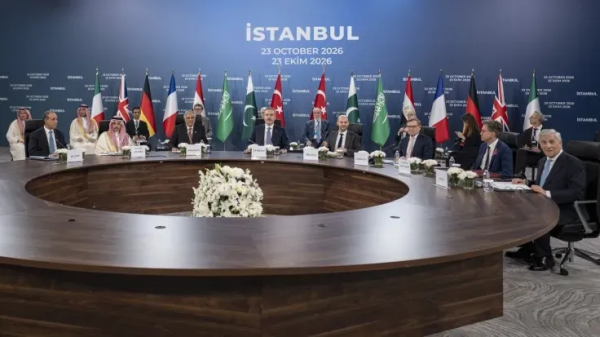
Foreign ministers from eight European and Eastern nations held an unprecedented meeting in Istanbul on October 23, 2026, launching a new interregional platform known as the E4-R4 format. The diplomatic venue brought together Turkey, Saudi Arabia, Egypt, Pakistan, Germany, France, the United Kingdom, and Italy. The coalition formed primarily due to the inability of traditional United Nations bodies to stop the crisis in maritime logistics and prevent wider war in the Middle East.
Securing Trade Routes
The participants focused on three interconnected crises: Houthi attacks on tankers in the Bab el-Mandeb and the Strait of Hormuz, the risk of full-scale US and Israeli strikes against Iran, and threats to commercial shipping in the Black Sea caused by the Russia-Ukraine war. Turkish Foreign Minister Hakan Fidan said the Black Sea must not be turned into a closed combat zone and proposed a dedicated legal framework to protect commercial dry-cargo vessels. Cairo supported this position. Egyptian Foreign Minister Badr Abdelatty noted that uninterrupted grain imports are critical, pointing to Egypt’s millions of dollars in losses from reduced transit through the Suez Canal.
The European bloc linked the military risks directly to economic survival. German Foreign Minister Johann David Wadephul accused Russia of attacking grain corridors and warned Tehran against commercial blackmail. British minister Ed Miliband stated that fuel supply disruptions are driving up prices at European gas pumps. The talks concluded with a unanimous warning to Washington and Tel Aviv: the group rejected any preemptive military strike on Iran that could pull the region into an uncontrollable catastrophe.
First Practical Steps of the E4-R4 Format
Because the E4–R4 format was designed as a rapid crisis-response mechanism, the ministers moved straight to practical action after issuing a joint statement. Implementation of the follow-up plan began almost immediately.
On October 26, a senior delegation from Turkey, Saudi Arabia, and Pakistan arrived in Tehran for talks with President Masoud Pezeshkian. The envoys delivered a demand to halt Houthi attacks in exchange for a European commitment to curb military pressure from Washington. Tehran agreed, on the condition that the maritime blockade on its ports be lifted.
Simultaneously, the parties launched a Black Sea exceptions mechanism: Turkey took on the insurance and monitoring of vessels carrying food, while Britain and France guaranteed financial backing to shield dry-cargo ships from strikes. The format was formally established as a permanent body with emergency communication hotlines between foreign ministries. In addition, the participants agreed on a plan to reconcile rival administrations in Libya, aiming to stabilize southern borders and reduce migration pressure on Italy and France.
Washington’s Reaction
The creation of the format caused unease in the United States, where the shift toward regional control was perceived as a challenge to traditional dominance. Some within the American foreign policy establishment viewed separate negotiations between key allies and Tehran as a dangerous precedent. Even so, the Trump administration has been forced to quietly support the group’s efforts, as escalating conflict with Iran and surging fuel prices threaten severe losses for the ruling party in upcoming congressional elections.
Prospects for the E4-R4 Format
NEWSROOM IN notes: over the past two years, global security institutions have proved ineffective, limiting their response to resolutions that warring parties openly ignored. Western naval operations only partially mitigated threats in the Bab el-Mandeb without resolving the root causes of the attacks. If the Istanbul coalition succeeds in keeping trade straits open and establishing neutral status for food corridors in the Black Sea, it will be a clear diplomatic success for the new alliance. For Turkey itself, this offers a chance to realize a key initiative that Ankara has advocated for years through the Antalya Diplomacy Forum (ADF): restoring practical diplomacy to a fragmented world.