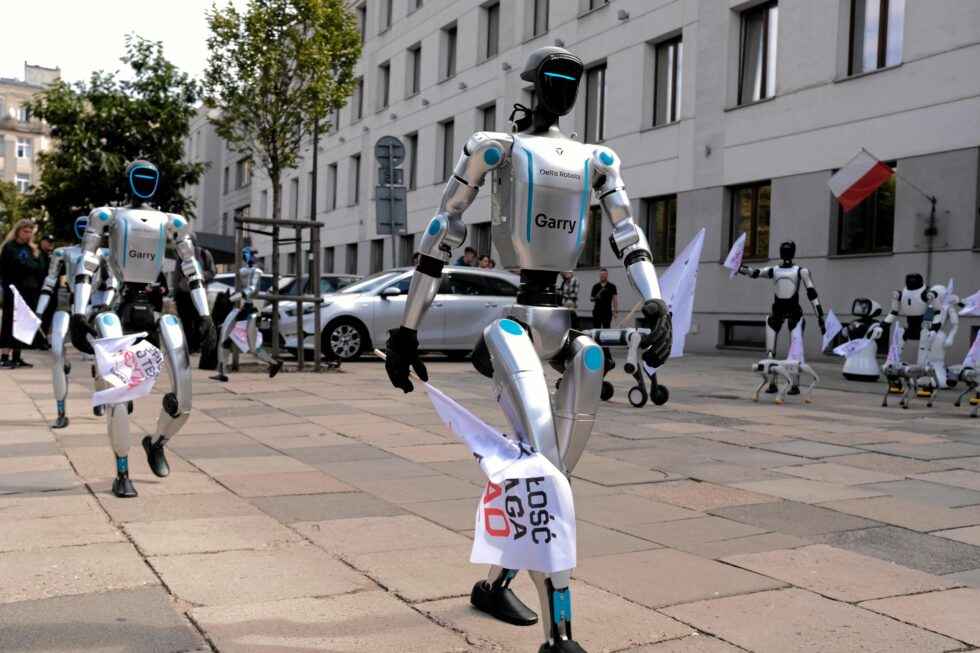
Robots in Warsaw have rallied against the pervasive spread of AI across all market sectors. Roughly thirty humanoid robots, accompanied by robotic dogs, staged what was likely the city’s most unusual demonstration. Formed in several rows, the robots waved Polish flags and chanted slogans such as: “We want regulation, we want rules, we want laws” and “Do not wait, regulate, protect jobs,” according to Notes From Poland.
Demonstrators called on the government to enact legislation regulating the deployment of artificial intelligence, warning that a failure to intervene would result in mass unemployment.
Who Organized the Protest
The demonstration was organized by Grzegorz Kulis, IT Director at robotics company Delta Robots. He acknowledged to the news outlet Gazeta.pl that the campaign “also holds PR value” for the firm. However, he added: “Although we use robots, we are still human, and we have many concerns that if we do not regulate this, we will soon find ourselves in an unprecedented situation that no human will be able to handle.”
“We are constantly discussing the impact of migrants on our society, while the vast majority of ‘migrants’ will arrive either via undersea cables across the Atlantic as artificial intelligence agents, or as humanoid robots in shipping containers from China,” he warned.
Poland’s Minister of Digital Affairs, Krzysztof Gawkowski, attended the rally. He assured the organizers that the ministry shares the protesters’ concerns and announced plans to establish an AI development and safety committee, as well as introduce regulatory “sandboxes” where companies can test AI-driven solutions ahead of broader implementation, local news website O!Polska reported.
Nevertheless, Kulis told Gazeta.pl that the draft bill on artificial intelligence systems currently under consideration by the Sejm, the lower house of the Polish parliament, provides insufficient practical protections for workers affected by automation.
NEWSROOM IN recalls: mathematicians Tristan Buckmaster and Levent Alpoge, who are working toward resolving one of the “Millennium Problems,” accused OpenAI of “front-running” (plagiarizing) their mathematical breakthrough. The incident dealt a significant blow to OpenAI’s reputation and raised a pointed question: could AI assistants become an instrument for legally expropriating intellectual property in favor of those commanding the most servers?