U.S. President Donald Trump begins his official Trump Beijing visit from May 13 to May 15, 2026, to meet with Chinese President Xi Jinping. This marks the first visit by an American leader to China in nearly a decade. The summit program focuses on resolving global geopolitical crises and establishing a new framework for economic relations between the two superpowers.
The Oil Hub: Middle East and the Strait of Hormuz
The situation regarding Iran is a central theme of the negotiations. Washington is seeking Beijing’s mediation to pressure Tehran to unblock the Strait of Hormuz. Navigation in the region is currently paralyzed due to war, which directly affects China, as more than 30% of Chinese oil imports pass through this route. Trump anticipates that the threat of an energy collapse will serve as a decisive argument for Beijing to restrain Iran.
Trump Beijing Visit: Trade and the “Trade Council”
In the economic portion of the talks, Trump intends to secure firm commitments from China to purchase American goods, primarily agricultural products. Discussions are underway regarding the creation of a bilateral “Trade Council” to monitor deal implementation. In exchange, the U.S. is prepared to discuss stable supplies of rare earth metals and tariff concessions, while also raising the issue of limiting China’s financial support for Moscow.
Tech Delegation and Business “Magic”

To emphasize business priorities, Trump included several top IT executives in his delegation. Tesla CEO Elon Musk traveled to China aboard Air Force One, while Nvidia CEO Jensen Huang joined the group during a refueling stop in Alaska. Tim Cook of Apple also traveled to Beijing. Before landing, Trump posted on social media that he intends to ask Xi Jinping to “open China” so these “brilliant people can work their magic” and assist in China’s development.
Delegation Curiosities: Marco Rubio and the “Maduro Suit”

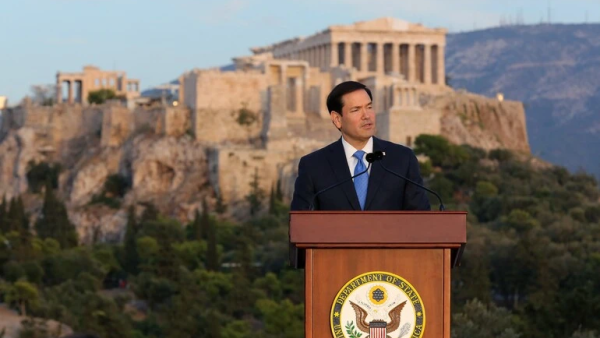
Particular attention has been focused on Secretary of State Marco Rubio. To bypass existing Chinese sanctions against him, Chinese authorities altered one character in the transliteration of his name in official documents. Rubio’s appearance on Air Force One in a Nike Tech tracksuit drew significant commentary, as the outfit mirrored the look of Nicolás Maduro at the time of his capture by U.S. special forces in January 2026. The White House press office referred to the choice as a “full circle moment.”
The Taiwan Issue and Investment Package
The issue of Taiwan remains the most sensitive point of discussion. Beijing is offering Washington large-scale investment packages for American infrastructure in exchange for a reduction in military aid to the island. Trump, in turn, is using the arms supply issue as leverage to obtain more favorable trade terms and ensure the security of maritime routes in Asia.
NEWSROOM IN notes that a year ago, U.S.-China relations were so strained due to reciprocal trade tariffs (reaching 145%) and tensions from the Joe Biden administration that a meeting between Trump and Xi seemed impossible. However, the U.S. president has arrived in China, following a gesture of goodwill in which China transferred two pandas to the Atlanta Zoo. Loaning these rare bears is a classic example of “panda diplomacy” — Beijing’s long-standing strategy of sending animals abroad as a symbol of trust and strengthening ties.
The tradition of panda diplomacy between the two countries began in 1972 following U.S. President Richard Nixon’s visit to Beijing. At that time, China sent a pair of pandas, Ling-Ling and Hsing-Hsing, to the United States.
This tool depends strictly on the political agenda. During periods of diplomatic cooling, China does not renew contracts and recalls the animals. This occurred with Japan in early 2026, when the last remaining pandas in Tokyo were returned home amid deteriorating relations. As a result, Japan is without these animals for the first time since 1972. Previously, in 2023, China recalled all pandas from the U.S. due to declining diplomatic relations.