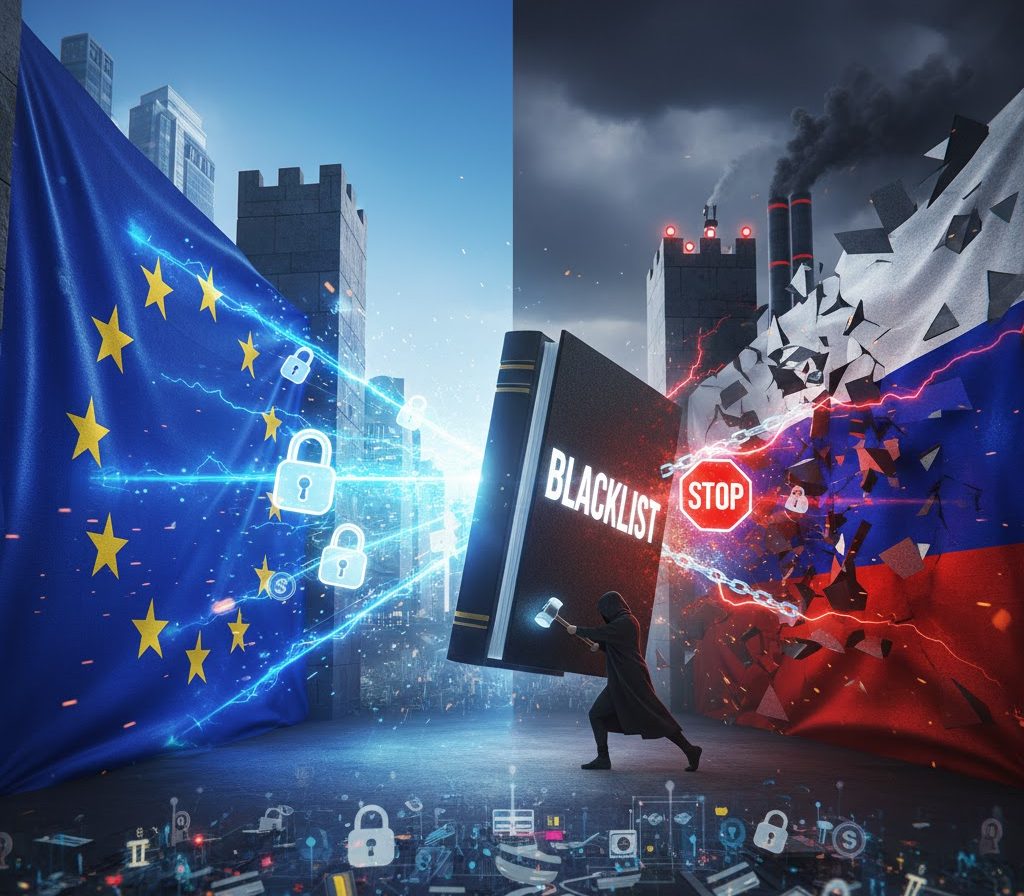
The European Union plans to add Russia to its high-risk blacklist of countries vulnerable to money laundering and terrorism financing (AML/CFT). This list currently includes nations such as Iran, North Korea (DPRK), and Afghanistan. This information comes from Politico, citing sources and a draft EU document.
How Does This Differ from FATF?
NEWSROOM IN notes that the EU’s decision (if approved) is significant because it is being taken separately from the Financial Action Task Force (FATF):
The FATF (Financial Action Task Force) is, simply put, the global ‘financial police’ that ensures money acquired through criminal means (corruption, drug trafficking, fraud) or designated for terrorism cannot move freely through the world’s banking systems.
This marks the first time the European Union is acting independently using its own mechanism. This move was reportedly made possible by the creation of a new EU supervisory body, the Anti-Money Laundering Authority (AMLA), which will be involved in compiling this list starting in 2027.
Financial Implications of the Russia EU Blacklist
Inclusion on this blacklist entails serious financial consequences:
☛ Enhanced Due Diligence: All financial institutions in the EU (banks, investment firms) will be required to strengthen the comprehensive vetting of all transactions linked to Russia.
☛ Request for Additional Information: European officials will demand more documentation concerning the beneficiaries (ultimate owners) and the origin of funds in transactions involving Russian entities.
☛ Restriction of Cooperation: Banks that have maintained any ties or minimal risks until now will be forced to further reduce or completely cease cooperation with Russian counterparties.
☛ Transaction Delays: Transactions linked to Russia may be significantly slowed down and require additional approval from special commissioners.
Essentially, this EU measure will complicate any legitimate financial flows between Russia and the European Union, increasing financial pressure and risk for any business attempting to deal with Russian entities.
BONUS FROM NEWSROOM IN
Since the start of the full-scale invasion of Ukraine in 2022, several countries and international organizations have adopted resolutions and decrees recognizing Russia as a terrorist state or a state sponsor of terrorism. The precise legal wording varies slightly across different countries and organizations (e.g., “terrorist state” or “state sponsor of terrorism”). Below is a list of the countries and organizations that have adopted such decisions:
| Country | Date of Decision | Note |
| Lithuania | May 2022 | The first country to recognize Russia as a “terrorist state” |
| Ukraine | July 2022 | Declared Russia a “terrorist state” |
| Latvia | August 2022 | Declared Russia a “state sponsor of terrorism” |
| Estonia | October 2022 | Declared the Russian regime “terrorist” |
| Czech Republic | November 2022 | Declared the Russian regime “terrorist” |
| Netherlands | November 2022 | The House of Representatives recognized Russia as a “state sponsor of terrorism” |
| Poland | December 2022 | Recognized Russia as a “state using methods of terrorism” |
| Slovakia | February 2023 | Parliament recognized Russia as a “state sponsor of terrorism” |
International Organizations (Parliamentary Assemblies)
| Organization | Date of Decision | Wording |
| Parliamentary Assembly of the Council of Europe (PACE) | October 2022 | Declared the Russian regime to be terrorist |
| NATO Parliamentary Assembly (NATO PA) | November 2022 | Adopted a resolution designating the regime in the Russian Federation as terrorist |
| European Parliament | November 2022 | Recognized Russia as a state sponsor of terrorism |
| OSCE Parliamentary Assembly (OSCE PA) | July 2023 | Declared Russia a country sponsoring terrorism |
Status in the US
The U.S. State Department maintains its own official legal list of “State Sponsors of Terrorism” (which includes Cuba, Iran, North Korea, and Syria). Despite relevant resolutions passed in the Senate, the State Department has not officially added Russia to this list.
In 2022, Anthony Blinken (who was the U.S. Secretary of State at the time) stated that existing sanctions already achieved an analogous effect.