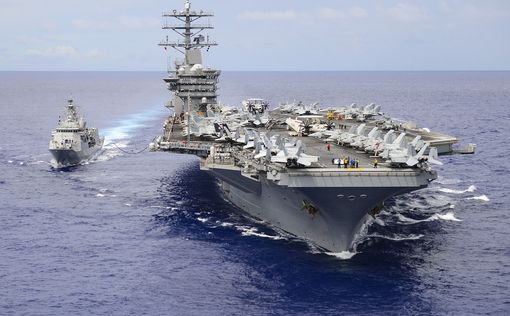
The United States has deployed an aircraft carrier strike group led by the nuclear-powered USS Nimitz to the Caribbean, highlighting the escalating USS Nimitz Cuba standoff following the unsealing of US criminal charges against 94-year-old former Cuban leader Raul Castro. While Washington characterizes the deployment as a demonstration of strength, Havana has condemned the move as direct preparation for a military invasion of Cuba. The deployment was officially confirmed by the White House on May 21, 2026.
USS Nimitz Cuba Deployment Begins Amid Economic Blockade
U.S. Southern Command (USSOUTHCOM) announced the arrival of the USS Nimitz (CVN 68) in its operational area in the Caribbean Sea. According to a post on the official USSOUTHCOM X account, the flagship is accompanied by the guided-missile destroyer USS Gridley (DDG 101) and the replenishment oiler USNS Patuxent (T-AO 201). U.S. military leadership described the deployed group as a “benchmark of combat readiness, strategic superiority, and unmatched lethality.”
The naval deployment comes during a severe economic collapse in Cuba. Due to a tight maritime and energy blockade by the US, Havana has experienced critical shortages of crude oil and petroleum products for several months. Reduced shipments from Venezuela have led to rolling blackouts across the island and a widespread humanitarian crisis, as reported by iHeartRadio. US President Donald Trump stated that the White House is monitoring the situation but emphasized that sending the ships is a political tool, adding that “the Cuban regime is already collapsing from within.”
Regime Change Efforts and Donald Trump’s Executive Order
The US naval deployment was prompted by federal charges filed in absentia against Raul Castro for conspiracy to murder US citizens. The charges relate to the 1996 shootdown of two civilian aircraft operated by the group Brothers to the Rescue. Sources cited by The New York Times claim Washington’s ultimate goal is to arrest and extradite the 94-year-old Castro to the United States, following a scenario similar to the recent ouster and detention of former Venezuelan President Nicolas Maduro. Trump’s push for total regime change in Havana is now backed by a formal legal framework.
In January 2026, Donald Trump signed Executive Order 14380, classifying the actions of the Cuban government as an “unusual and extraordinary threat” to US national security and foreign policy. The document alleges that Cuba openly hosts advanced military and intelligence facilities for Russia, China, and Iran, and maintains direct links to Hamas and Hezbollah. According to Trump’s executive order, the island hosts Russia’s largest foreign electronic signals intelligence (SIGINT) facility, which is used to intercept sensitive US data.
Havana Accuses Washington of Fabricating Pretexts for Aggression
Cuba’s current president, Miguel Diaz-Canel, strongly condemned the White House’s actions, calling the prosecution of Raul Castro a political stunt. According to The Guardian, the Cuban leader stated that the legal case lacks any legal basis and is aimed solely at “justifying the recklessness of an upcoming military aggression.” Cuban authorities warned the Trump administration that any attempt at expansion would lead to unpredictable consequences and bloodshed throughout Latin America.
Diplomatic Standoff Deepens Over USS Nimitz Cuba Presence
Amid these tensions, Cuban diplomats are attempting to keep channels open for a compromise by appealing to the international community. Cuba’s Ambassador to the UN, Ernesto Soberon Guzman, emphasized in an interview with American journalists that Havana is ready to discuss any issue with Washington, including governance and economic reform, but only on the principles of mutual respect and equality. According to the diplomat, the aggressive rhetoric from the White House and slogans suggesting readiness to take control of Cuba completely destroy trust, while fabricating historical pretexts for intervention shows a lack of willingness to engage in honest dialogue.