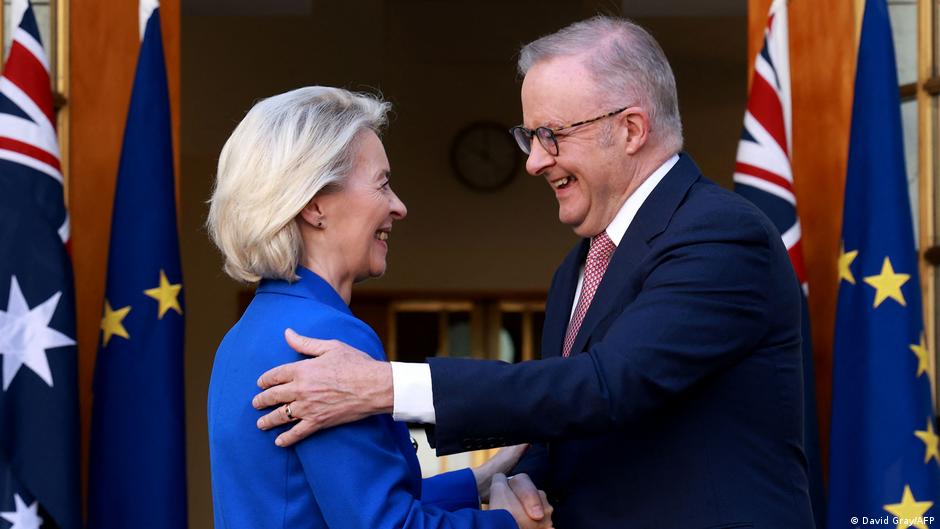
The EU-Australia trade negotiations have officially concluded, with Brussels and Canberra signing a comprehensive package covering trade, defense, and science. The deal, finalized by European Commission President Ursula von der Leyen and Australian Prime Minister Anthony Albanese, is pragmatic in its goals. Europe is seeking new markets and independent sources of raw materials, while Australia aims to secure a reliable military and economic partner amid increasing global instability.
EU-Australia Trade Agreement
Brussels and Canberra have agreed to eliminate tariffs on nearly all European exports, covering 99% of all goods. For European businesses, this means annual savings of approximately one billion euros in customs duties alone. European Commission analysts expect European exports to Australia to increase by one-third over the next decade. The primary beneficiaries will be the European automotive, chemical, and dairy industries. Additionally, Australia has committed to strictly protecting over 2,000 European geographical indications. This means it will be prohibited to produce Australian versions of French Comté cheese, Lübeck marzipan, or Irish whiskey using those specific names.
In exchange for open markets, Europe gains stable access to critical raw materials. Australia is rich in lithium, aluminum, and manganese. These metals are essential for manufacturing electric vehicles, smartphones, batteries, and certain medications. Streamlined access to Australian resources is intended to reduce the EU’s total dependence on Chinese supplies.
Military Ties
Alongside economic cooperation, the parties have strengthened military ties. The signed security partnership formalizes previous informal cooperation. The EU and Australian militaries and intelligence services will now officially coordinate maritime actions, defend against cyberattacks, counter hybrid threats, and jointly develop artificial intelligence for the defense sector.
Practical implications: EU and Australian warships can now legally conduct joint patrols in the Indo-Pacific region to protect trade routes. Intelligence services in Brussels and Canberra are establishing a direct channel to exchange data and cybersecurity methods. The EU gains a military foothold in Asia, while Australia diversifies its security to avoid complete reliance on the United States.
The Horizon Europe Science Program
Additionally, Australia will begin integration into Horizon Europe, the world’s largest research funding program. This will allow scientists from both continents to collaborate on shared projects.
What has changed: Australia is officially joining the program as an associate member, paying annual contributions to the common EU fund.
Practical implications: Administrative barriers have been removed. Australian institutes, laboratories, and tech startups can now apply for European grants — part of a roughly 100-billion-euro budget — on equal terms with French, German, or Italian entities. They can lead projects, hire European specialists, and receive funding directly from Brussels.
What will this agreement bring to the average European, and what are the trade-offs?
For average EU citizens, the benefits are tangible. First, the projected growth in exports is expected to support job creation and wage stability at European factories. Second, supplies of lithium and aluminum from Australia will help stabilize prices for electronics and green technologies, protecting consumers from price spikes caused by trade tensions in Asia. Third, the agreement simplifies labor migration: European engineers, researchers, and IT specialists will find it easier to obtain work visas and contracts in Australia. Finally, consumers may see more affordable Australian goods, such as wine and minerals, on supermarket shelves due to the removal of duties.
However, the deal has its costs, which are likely to be borne by European farmers. The primary risk is the impact on local agricultural producers. Despite strict import quotas set by Brussels, the European market will see an influx of high-quality, cheaper Australian beef, lamb, rice, and sugar with zero tariffs. While this may help curb food price inflation for urban consumers, it means lost income and increased competition for European livestock farmers. Furthermore, the agreement requires strict environmental compliance throughout the supply chain. Transitioning to these standards may impose additional costs on small and medium-sized businesses in Europe, which could eventually be reflected in the price of certain services.
When will the agreement take effect?
The agreement must be approved by the Council of the EU, the European Parliament, and Australian institutions before it enters into force. If the process proceeds without delays, ratification is expected to take approximately one to one and a half years.