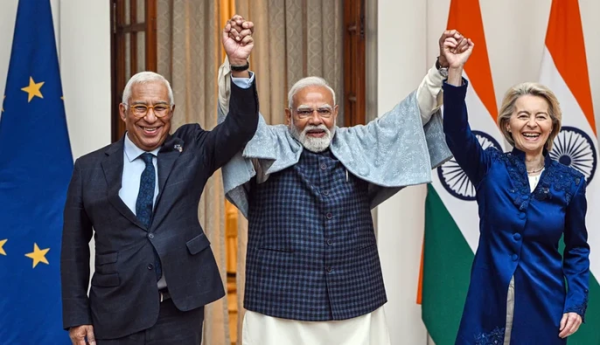
The European Union and India officially announced the conclusion of the monumental EU-India Trade Deal (a Free Trade Agreement, FTA) on January 27, 2026. Negotiations for the deal spanned nearly 20 years, beginning in 2007. Indian Prime Minister Narendra Modi dubbed the agreement the “mother of all deals.”
“Mother of All Deals”: Facts and Figures
What makes this agreement so monumental? First, the market size covers over 2 billion people. Second, the deal radically lowers barriers for European goods, impacting 96.6% – 97% of trade. Specifically, duties on European automotive products will fall from 110% to 10% over five years; tariffs on wine will be reduced from 150% to 75% initially, with a long-term goal of 20%; and duties on olive oil will be eliminated completely within five years.
European exports to India are expected to double by 2032, and European businesses will save up to 4 billion euros annually in customs duties.
Why This Matters to Every European
India is much more than just tea and movies; as of 2026, it is the fastest-growing market and the planet’s largest tech hub. The alliance with India grants Europe five key advantages:
- Independence from China. Remember the chip and medicine shortages? India is set to become Europe’s “safe factory.” Distributing production between the EU and India guarantees stable prices and product availability in stores.
- The Battle for Talent. Europe suffers from a critical shortage of IT specialists and engineers. Instead of poaching them individually, the EU and India have agreed on the mutual recognition of diplomas and the adoption of a “Digital Wallet.” This wallet—a digital ID covering passports, driving licenses, and, crucially for this agreement, educational diplomas and qualification certificates—means European companies can hire top specialists faster, and European students can intern in India’s tech hubs.
- Cheaper Energy Future. India is building solar and wind farms on a gigantic scale. By combining India’s resources with our technology (green hydrogen), we can faster break free from gas dependency and make clean energy accessible. This is a direct path toward lowering electricity bills in the future.
- Connectivity and Travel. The joint Blue Raman project (an undersea cable) connecting Europe, Africa, and India provides greater assurance that our internet won’t “crash” if a cable is cut in the Atlantic. It acts as an ultra-high-speed backup route for global traffic. Regarding visas, the parties have agreed to fully digitize the application process. This will shorten consulate queues and reduce the chances of document forgery.
- Security. India and the EU have signed their first comprehensive defense and security agreement, covering maritime safety, cyber threats, space, and counter-terrorism. This means the world gains another powerful force capable of maintaining order along vital sea lanes (which carry our goods) without constantly having to rely on the US or fear pressure from Russia.
The agreement is scheduled to enter into force in early 2027, transforming India into Europe’s chief strategic ally in Asia. If all goes as planned, our economies will become more stable, and life will become more affordable.
NEWSROOM IN notes:
Last May, the UK and India concluded a free trade deal covering 99% of Indian exports and 90% of British exports, significantly simplifying the trade turnover between the two countries.
Alongside the Free Trade Agreement—the UK’s largest deal since leaving the European Union—both parties also signed a double taxation convention, which will simplify business operations.