Early Serbia elections on October 25, 2026, brought a fundamental shift in the balance of power, ending the ruling coalition’s hold on government. With returns counted from more than 97% of polling stations, the opposition movement “Student List – Students Win” won an absolute majority with 52.6% of the vote. Former President Aleksandar Vucic conceded defeat for his Serbian Progressive Party (SNS) before official ballot counting had concluded.
NEWSROOM IN examines how a protest coalition formed just a month ago defeated the party that governed Serbia for 14 years (from 2012 to 2026), as well as Vucic himself, who led the country as prime minister from 2014 to 2017 and as president from 2017 until September 2026.
An Attempted Castling Move
Regular elections to the National Assembly (Serbia’s parliament) were originally scheduled for December 2027, and the presidential election no later than April 2027. Vucic’s second presidential term was set to end in May 2027, and under the constitution, he was barred from running for another term as head of state.
Under the Constitution of Serbia, the country is a parliamentary republic where the government, headed by the prime minister, holds primary executive authority. The prime minister determines state policy, forms ministries, and manages the budget. The president holds primarily representational and coordinating duties, representing Serbia domestically and abroad, signing legislation into law, and serving as commander-in-chief of the armed forces. As president, Aleksandar Vucic held vast authority not because of his constitutional powers, but for political reasons: he remained leader of the ruling party, which held an absolute parliamentary majority. Prime ministers, including Ana Brnabic, were his direct allies and essentially technical figures who coordinated every decision with him.
On September 9, 2026, Vucic dissolved parliament, and later that month resigned from the presidency. He intended to win the snap election alongside his party and retain de facto leadership of the country as prime minister, an office without term limits. Vucic said the snap election was necessary to overcome a prolonged political crisis. He sought to reset the political landscape on the assumption that the street protest movement would not have enough time to organize into an effective electoral force. Instead, the move backfired, costing him both the country’s top offices and his parliamentary majority.
Serbia Elections Breakdown and Record Turnout
After processing returns from 8,077 of 8,392 polling stations, the Republic Electoral Commission (RIK) and election observers CeSID/Ipsos recorded an opposition lead exceeding 500,000 votes. The Student List won over 2.21 million votes (52.54%–52.6%), securing approximately 140 seats in the 250-member National Assembly. The bloc “Aleksandar Vucic – United Serbia” received 39.2%–39.29% (roughly 1.65 million votes), securing at most 103 to 105 seats. No other nationwide party crossed the 3% threshold, with the remaining five seats allocated to national minority parties.
Voter turnout set a post-1992 record since the dissolution of Yugoslavia, with preliminary data indicating that around 70% of the 6.45 million registered voters cast ballots.
The Novi Sad Disaster as a Catalyst for Change
The primary trigger for the protest wave was the disaster in Novi Sad. In November 2024, a concrete canopy collapsed at the city’s newly renovated central railway station, killing 16 people ranging in age from six to 74, including children, and severely injuring several others.
The station had undergone two recent renovations, in 2021 and 2024, carried out by the Chinese CRIC-CCCC consortium. Authorities claimed the canopy, built in 1964, was not part of the renovation project. Independent experts, however, established that negligence during roof repairs caused the collapse. The public blamed corruption in public infrastructure contracts. Students and young people took to the streets first, demanding accountability, resignations, and the prosecution of officials who signed the contract. Protests under the slogan “Corruption Kills” continued for nearly two years.
Law enforcement authorities arrested more than 20 people in connection with the Novi Sad collapse, including a minister, senior government officials, and construction inspectors. Investigators stated that officials inflated invoices by millions of euros, signed falsified completion certificates, and ignored the dangerous condition of the canopy’s suspension cables.
The Political Confrontation
The campaign centered on a direct clash between the established political leadership and the new civic movement. The opposition Student List nominated university professors, doctors, and activists, deliberately refusing alliances with career politicians. The movement held three key advantages over traditional parties:
- An unblemished reputation: Having no ties to previous governments, candidates gave state-aligned media little leverage for smear campaigns.
- A clear agenda: Setting aside abstract geopolitical debates, the movement prioritized education reform, judicial independence, and criminal liability for corruption in the construction sector.
- Mobilizing non-voters: The students re-engaged disillusioned citizens who had abstained from voting for years after losing faith in political change.
Who Will Lead the New Government
Under Serbian political practice, the leader of the winning list becomes prime minister. Ilija Srdanovic, a 56-year-old practicing cardiologist and professor at the University of Novi Sad Faculty of Medicine, is expected to assume the post.
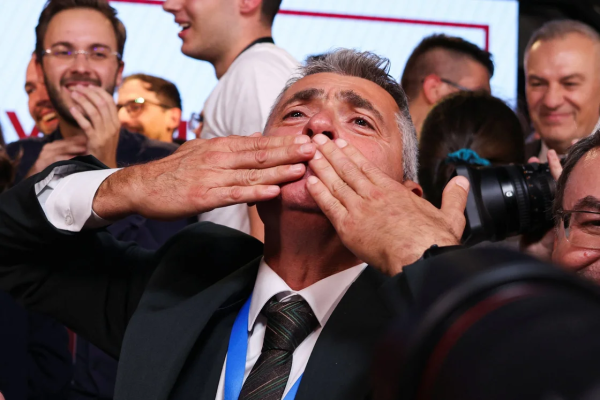
University of Belgrade Rector Vladan Djokic was originally planned to lead the list, but student delegates rejected his candidacy over internal disagreements. In September 2026, students endorsed Srdanovic, who had supported youth protests from the outset. He ran on an uncompromising anti-corruption platform, stating at an event in Novi Sad: “The authorities will not find those responsible for the tragedy because they are the main culprits. They pushed corruption to the point where it began to kill.” Celebrating the victory at campaign headquarters, Srdanovic thanked voters for their support.
“We are deeply grateful to the free citizens of our country for recognizing the genuine values upheld by the student movement. We were just one part of it—a small cog—that ultimately accomplished what was expected of us: delivering a shared victory in the parliamentary election and freeing the country from tyranny,” Srdanovic told the BBC.
Aleksandar Vucic’s Adversaries
Although Vucic quickly conceded defeat, he attributed his opponents’ victory to hostile foreign forces, pointing to European nations and the American “deep state.” Speaking at campaign headquarters after preliminary results were announced, Vucic described the victors as “merely executing dirty work conceived by someone else to destroy a sovereign state.” He asserted that the new Serbian government would impose sanctions on Russia by March or April 2027.
Five days before the vote, on October 20, 2026, veterans of Serbia’s security services issued a notable public statement. Around 150 former police officers, leaders from the Security Intelligence Agency (BIA), and military intelligence personnel—including former majors, captains, and lieutenants—reminded active-duty officers that their duty is to the country and the Serbian people, not to individual parties or leaders.
The authors stressed that neither political interests, orders from superiors, nor government pressure can justify breaking the law, noting that each officer carries individual responsibility for their actions or deliberate inaction. They urged active colleagues to prevent any attempts at electoral fraud, blackmail, and voter intimidation. The statement placed special emphasis on securing polling stations after closing to ensure an accurate count and lawful certification. In the event of post-election demonstrations, they urged police to remain completely impartial, avoid using force against peaceful demonstrators, and protect the constitutional right to peaceful assembly.
The appeal drew widespread attention, with Serbian analysts and journalists drawing comparisons to the 2000 “Bulldozer Revolution,” when security forces refused to carry out Slobodan Milosevic’s orders, leading to a change of power.