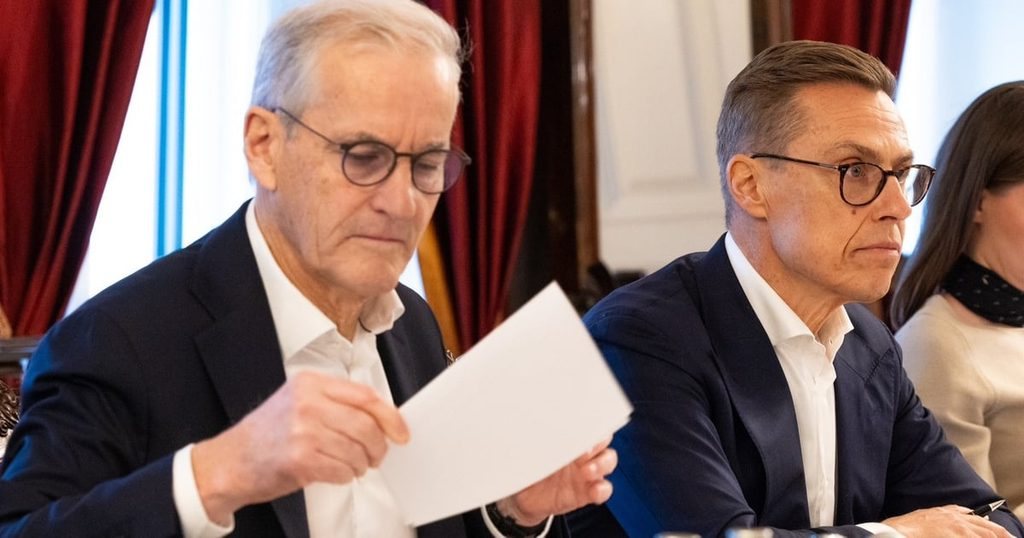
Finnish President Alexander Stubb and Norwegian Prime Minister Jonas Gahr Støre held a 90-minute phone call with Russian President Vladimir Putin on October 27, 2026. Speaking at a Nordic Council session in Helsinki, the Finnish leader said the joint Putin phone call was prepared in close coordination with Volodymyr Zelenskyy and U.S. Special Envoy Steve Witkoff. Immediately following the call, Ukrainian officials received a 30-minute briefing on the messages delivered, chief among them a demand to halt strikes on civilian infrastructure ahead of a four-way meeting planned for November in Abu Dhabi.
Diplomatic Demarche Over Putin Phone Call
Despite Kyiv’s endorsement of the initiative, the talks drew sharp criticism from Danish Prime Minister Mette Frederiksen. During an official visit to Helsinki, Frederiksen publicly rebuked her counterparts’ actions on their home turf, calling the outreach “going solo” and a dangerous step that divides Europe. The demarche directed at Finnish leadership marked a rare departure from traditionally restrained Nordic diplomatic protocol.
Copenhagen’s criticism stands in sharp contrast to the recent crisis over Greenland. When Donald Trump’s claims to the Arctic island jeopardized Danish national interests, Frederiksen did not wait for multilateral consensus in Brussels. Instead, she initiated direct contact with the White House, activated bilateral diplomatic channels, and personally negotiated compromise defense arrangements. Yet when Helsinki and Oslo employed the exact same approach to safeguard their own land and maritime borders, Denmark characterized the move as a breach of European discipline.
The divergent approaches are largely dictated by geography. With no direct land or maritime border with Russia, Denmark can comfortably pursue total diplomatic isolation of Moscow. Finland and Norway, by contrast, share hundreds of kilometers of land and sea borders with Russia and must preserve emergency lines of communication to prevent frontier incidents.
Beyond the Danish prime minister’s rhetoric lies another calculation. European media are actively debating candidates for the post of future EU special envoy to the Abu Dhabi talks, floating Alexander Stubb, European Council President António Costa, and Frederiksen herself as potential contenders. By calling out her colleagues for perceived softness, Frederiksen may be seeking to prove that she is the ideal hardline negotiator to represent Europe.
Jonas Gahr Støre pushed back firmly against the criticism: “Over the past four years, the EU has had no single opinion or single approach… We speak only for ourselves, but this issue was discussed in considerable detail, and all of our allies were informed in advance.”
Legal Autonomy vs. Union Solidarity
Challenges to the legality of Stubb’s and Støre’s outreach lack legal basis. Norway is not an EU member and is tied to its neighbors only through Nordic cooperation frameworks and NATO. As for Finland, under the Treaty on European Union, foreign policy and national security remain the sovereign prerogative of national governments. The leader of any member state retains the full legal right to conduct bilateral talks with foreign leaders.
While Article 24 of the Treaty commits member states to act “in a spirit of loyalty and mutual solidarity,” this serves as a political commitment rather than a legal ban. A formal mandate from the European Council is required in only two scenarios: when finalizing common commercial agreements, or when an official is tasked with speaking on behalf of all 27 member states. Stubb and Støre spoke strictly as heads of their respective sovereign states, leaving EU statutory norms intact.
A Diplomatic Trap
The call by Stubb and Støre stems directly from a broader crisis of European strategic agency. By committing to total diplomatic isolation of Moscow, the European Union left itself outside the core negotiating triangle of Washington, Moscow, and Kyiv. The EU’s official position that it cannot act as a neutral arbiter took root in May 2022, when former high representative Josep Borrell ruled out the bloc as a prospective mediator. In the spring and summer of 2026, EU foreign policy chief Kaja Kallas and European Council President António Costa reaffirmed this doctrine in tandem, stating that because the EU firmly backs Ukraine and protects its own borders, it cannot be impartial.
Kyiv backed this stance to ensure the EU would not need to dilute sanctions for the sake of neutrality. However, the consequence of this position is that the European Union has no seat at the negotiating table and plays no formal role in shaping armistice terms. Without regaining a diplomatic voice, the EU risks serving merely as a financial backer covering Ukraine’s bills.
Recognition of this isolation has prompted European capitals to forge alternative coalitions outside cumbersome institutional channels. Just last week, one such framework surfaced in Istanbul. On October 23, foreign ministers from Germany, France, the United Kingdom, and Italy held an emergency meeting with their counterparts from Turkey, Saudi Arabia, Egypt, and Pakistan under the E4-R4 format. The parties moved to direct coordination on safeguarding shipping in the Black Sea and de-escalating tensions in the Middle East. Against this backdrop, the independent outreach by Helsinki and Oslo represents a broader trend of regional actors taking crisis management directly into their own hands.