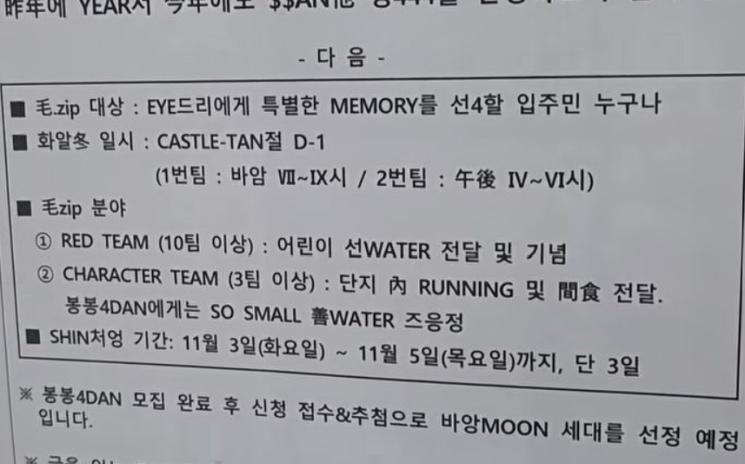
Coded notices seeking Santa Claus actors have appeared across elevators in South Korean high-rise apartment complexes ahead of the winter holidays. Parents are posting linguistic rebuses to preserve the holiday illusion for children who can already read, according to The Korea Herald. The initiative quickly spread beyond building chat groups to become a nationwide viral trend.
Phonetics and Hanja Characters
Adults are going to great lengths by mixing English words, Korean characters, and symbols. One widely circulated template reads: “$$AN他 毛ZIP 안내.” When read phonetically, the combination forms the phrase “Recruiting Santa Clauses.”
The encryption relies on phonetic substitutions and wordplay. The English word “eye” sounds like the Korean “ai” (아이), meaning child. The Korean word for “snow” forms the first syllable of the Korean verb “to notice.” The number 4 is read as “sa,” replacing the final syllable in the word “haengsa” (행사, event). For some puzzles, authors add hidden footnotes leading to another notice containing the decoding rules.
Social Media Reaction to Coded Notices
Photographs of the linguistic puzzles have spread widely across local online platforms. Users are solving the elevator notices and rating the authors’ ingenuity. The trend has drawn widespread praise. As one commenter noted online, “It seems the adults enjoyed creating the notices even more than the children enjoyed receiving the surprise.”
Context: Apartment Notice Boards
NEWSROOM IN notes: in South Korea, the vast majority of the urban population lives in dense apartment complexes, where paper notices in building entryways remain the primary tool for sharing neighborhood services. Previously, explicit notices hiring actors frequently spoiled the holiday for children. Now, linguistic masking is likely to become an annual pre-holiday custom. In future seasons, parents may have to devise more complex ciphers as a generation with smartphones learns to crack text puzzles faster than the neighbors themselves.