Several American publications have stirred the information space by reporting on secret consultations between representatives of Donald Trump’s administration and the Kremlin. According to these reports, a detailed peace plan to end the Russian-Ukrainian war is being developed, with a framework agreement potentially reached in the coming days.
NEWSROOM IN notes: There is currently no official confirmation of this information from the White House, the Kremlin, or Kyiv. The details about a secret plan, disseminated by American media, aim not to inform the public about a negotiation process, but rather to create a political reality and influence the negotiating positions of Ukraine and Europe.
The Alleged Plan’s Core Details
The publication Axios, citing U.S. and Russian officials, first reported that a peace plan to end the war is being developed by Trump’s team. This alleged plan reportedly comprises 28 points, divided into four categories: Peace in Ukraine, Security Guarantees, Security in Europe, and Future U.S. Relations with Russia and Ukraine.
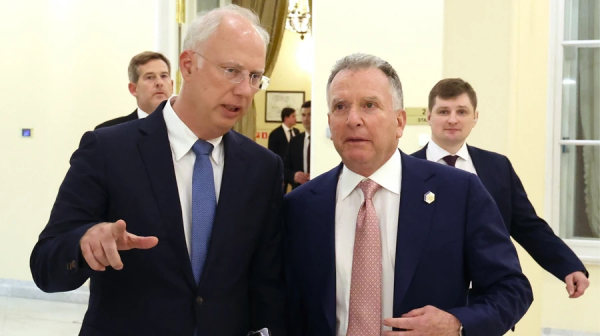
Steve Witkoff, identified as Trump’s special envoy, is named as the head of the plan’s preparation. He reportedly held detailed discussions with Russian special representative Kirill Dmitriev. Their meeting is said to have taken place in Miami from October 24–26.
The specific details of the plan regarding the issue of territories in eastern Ukraine remain unknown.
Kirill Dmitriev, the Russian participant in the consultations, claims the plan’s “main idea” is a return to principles previously discussed between Putin and Trump.
According to Dmitriev, the negotiation framework is “much broader — about how to finally ensure long-term security in Europe, not just in Ukraine.” He added that this time, “we feel that the Russian position is genuinely heard.”
Dmitriev also stated that the American side is now “explaining the benefits” of its current approach to “Ukrainians and Europeans” amidst “additional Russian successes on the battlefield.” However, he did not specify what these “benefits” or the approach entail.
Exclusion of Allies
Following Axios, Politico reported that a high-ranking White House official expects a framework agreement to end the war to be finalized by all parties by the end of November — possibly “this week.”
Sources from both publications confirm a highly sensitive detail: representatives from Ukraine and European countries are not participating in the development of this plan. However, according to a Ukrainian official, Witkoff did discuss it with Rustem Umerov, Secretary of Ukraine’s National Security and Defense Council (NSDC).
Why These Publications Show Signs of Disinformation
Reports of secret negotiations between the U.S. and Russia have surfaced repeatedly throughout the Russian-Ukrainian war. However, this particular instance exhibits all the hallmarks of a significant information manipulation campaign. Here’s why:
Pressure on Kyiv: Public statements about the alleged “benefits” for Ukraine, reportedly explained by Washington, and claims that the Russian position has been “heard”, may be designed to coerce Kyiv into accepting unfavorable terms.
Undermining Trust in the U.S.: The information leak deliberately highlights that key European allies are not involved in the plan’s development. This serves to erode confidence in U.S. leadership, creating the impression that Washington is acting behind its partners’ backs.
Selective Information: The plan reportedly consists of 28 points, yet the most critical category — the territorial question — remains undisclosed. Withholding key details maximizes anxiety among Ukrainians and Europeans, potentially forcing them to accept a plan that has not yet been published.
Deadline Pressure: Politico’s assertion that an agreement could be reached “as early as this week” creates an artificial sense of urgency and inevitability. This psychological pressure aims to compel Kyiv and European capitals to make a “foregone” decision quickly, without thorough analysis or public discussion.
Conclusion: It is highly probable that this information constitutes a deliberate information leak (or at least a heavily managed one), although this does not rule out the fact that consultations themselves occurred.
Regardless of whether this plan or another is implemented, it must be based on terms that are fair to Ukraine.