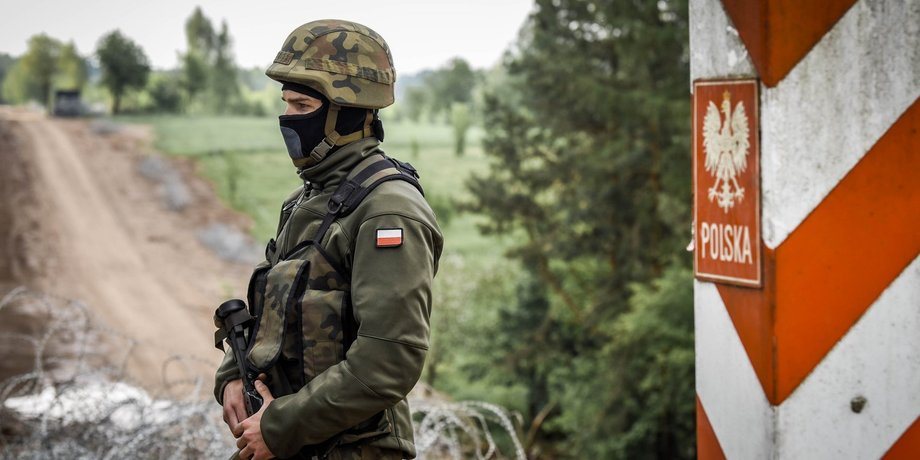
Polish police, backed by the army, intelligence agencies, and counterterrorism units, have launched a major Poland border security operation across the Warmian-Masurian and Podlaskie voivodeships. According to Police Commander-in-Chief Marek Boroń, the Military Intelligence Service and allied agencies warned Polish authorities in late October of potential Russian provocations, including possible infiltration attempts by armed groups. Boroń linked the operation directly to a growing number of sabotage incidents and hybrid operations by eastern intelligence services on Polish territory. A specialized command center has been established in Warsaw to coordinate the security response. The operation is preventative.
“This is directly connected to the sabotage and subversion taking place in our country, as well as the hybrid criminal actions of eastern intelligence services… We must protect residents of border areas and critical infrastructure from any situations that could pose a threat,” Boroń told RMF FM.
He denied that the security mobilization had any connection to the crisis surrounding the Constitutional Tribunal.
Poland Border Security and the Suwalki Gap
Warsaw has been steadily increasing its military presence along the border with Russia. By the end of 2026, Poland plans to form a dedicated Warmian-Masurian brigade tasked with border defense in the event of a Russian attack. Territorial Defense commander Cezary Kiszkowiak said the unit will secure the area around the Suwalki Gap, a strategic 100-kilometer corridor linking the Baltic states to NATO and separating Kaliningrad from Belarus. The brigade will reach full operational readiness within two years. Heavy military equipment, including South Korean K2GF Black Panther tanks, is already being moved into the region.
“Coalition of the Willing” Exercises
The border reinforcement coincides with multinational military maneuvers. According to Le Monde, exercises for the so-called “coalition of the willing” are scheduled for November 9–22 at the Nowa Dęba training ground in Poland. Nearly 2,800 troops from ten countries are set to take part. The initiative, led by France and the United Kingdom, potentially involves up to 36 nations. The stated goal is to test allied readiness to deploy forces rapidly inside Ukraine after hostilities end. NATO leadership has been notified, though the alliance is not directly running the exercise.
The Lithuanian Border
Lithuania shares similar border concerns. On October 7, Vilnius deployed military units to its border with Kaliningrad following an incident on the Latvia-Belarus border, where 20 migrants accompanied by armed men attempted to enter the European Union. Lithuanian officials cited the risk of aggressive border crossings amid possible Russian mobilization efforts. The additional Lithuanian units will remain in place at least through mid-November.
Origins of the Escalation
NEWSROOM IN notes: The latest escalation and heightened risk of provocations coincide with Russia’s November 4 national holiday, National Unity Day. Historically, the date marks the events of autumn 1612, when the Second Volunteer Army led by Kuzma Minin and Dmitry Pozharsky expelled Polish-Lithuanian garrisons from the Moscow Kremlin.
Russian state media regularly uses the anniversary to promote anti-Western messaging, framing Poland as a historical adversary that seeks to undermine Russian territory.
The November 4 date is also historically contested. Most 17th-century sources date the capture of Kitay-gorod by Minin and Pozharsky’s forces to October 22 (November 1 by the Gregorian calendar). An official dispatch from military commanders dated November 15, 1612, cites September 22, which historians P.S. Kazansky and A. Kondratyev identify as a clerical error.
The holiday was formally established on November 4 in 2005. Its primary purpose was to replace the Soviet public holiday of November 7, which commemorated the Bolshevik Revolution, while maintaining the traditional November holiday period.