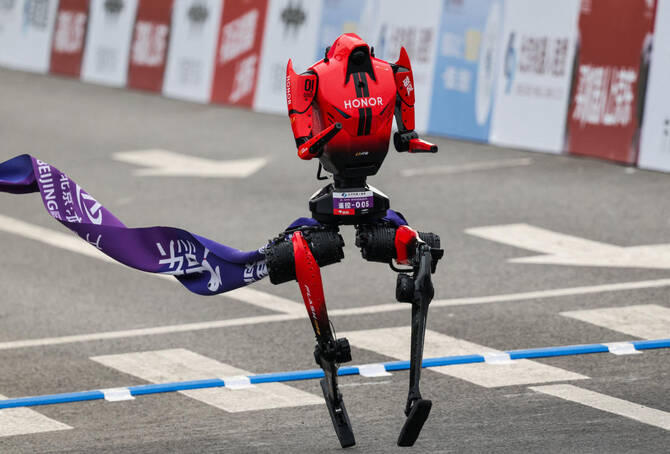
A large-scale race featuring a humanoid robot in China has demonstrated the rapid evolution of modern robotics. As part of a traditional half marathon featuring approximately 12,000 human runners, a separate category was established for machines. More than 100 humanoids took to the track, and their results prompted a reassessment of physical capability limits.
Race Rules and Robot Judging Nuances
According to the half marathon rules, the robots did not start in the general crowd. Instead, they started individually at 30-second intervals and moved along a specially designated track.
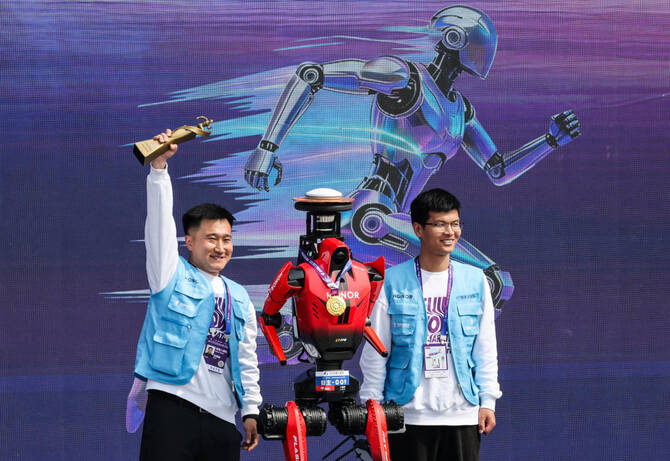
The distribution of rankings became the main point of interest. According to Global Times, a robot from the company Honor was the absolute leader of the race, crossing the finish line in 48 minutes and 19 seconds. However, this machine was remotely controlled. Under the competition regulations, the official victory was awarded to another Honor humanoid that used autonomous navigation exclusively. Its time was 50 minutes and 26 seconds.
Even considering the judging nuances, the result of the autonomous winner is historic. The machine officially surpassed the current human world record. For comparison, the best human result belongs to Ugandan Jacob Kiplimo (approximately 57 minutes).
| Participant | Navigation System | Time (21 km) | Status |
| Honor Robot (No. 1) | Remote Control | 00:48:19 | Exhibition only |
| Honor Robot (No. 2) | Autonomous Navigation | 00:50:26 | Official Winner |
| Jacob Kiplimo | Human (World Record) | ~00:57:00 | Human Record Holder |
Humanoid Robot Technological Leap and System Testing
Progress compared to last year is significant. In the previous race, the winning robot recorded a time of 2 hours and 40 minutes and required three mid-race battery changes. This year, the machines demonstrated autonomous stability, a fluid gait, and robust algorithms.
The result is a major departure from the world’s first full robot marathon, which took place in 2011 in Osaka, Japan. During that event, miniature bipedal robots approximately 30–40 cm tall covered a 42 km distance, NEWSROOM IN notes. The winner required 55 hours to complete the course.
Continuous running for 21 km serves as a rigorous test for visual perception, intelligent recognition, and battery endurance.
Zhao Mingguo, a researcher at the Department of Automation at Tsinghua University, stated that a robot’s ability to navigate the track independently is a serious test of maneuverability. Such competitions create a transition from laboratory testing to real-world application, providing engineers with data to develop “embodied intelligence” and motion control technologies.
Track Incidents and Assistant Robots
Despite the success for Honor, whose humanoids took all three podium spots, the race showed that the technology requires further refinement. One robot lost its balance and fell at the start, while another collided with a track barrier.
Robots also served in non-competitive roles. According to CCTV, one humanoid successfully worked as a traffic controller, directing athletes using gestures and voice commands.
The speed of the Honor winners is attributed to biomechanics and cooling. Engineer Du Xiaodi noted that the design was modeled after elite athletes. The machine features legs approximately 95 centimeters long and a high-performance integrated liquid cooling system. The company plans to apply these solutions in industrial settings in the future.